Odoo Slides & Videos
Presentation decks and explainer videos that Quartile has used at events and webinars, covering Odoo implementation, customization, Japanese localization, and open source community work.
| Last Update | 08/02/2026 |
|---|---|
| Completion Time | 2 hours 31 minutes |
| Members | 1 |
Share This Course
Share Link
Share on Social Media
Share by Email
Please login to share this Odoo Slides & Videos by email.
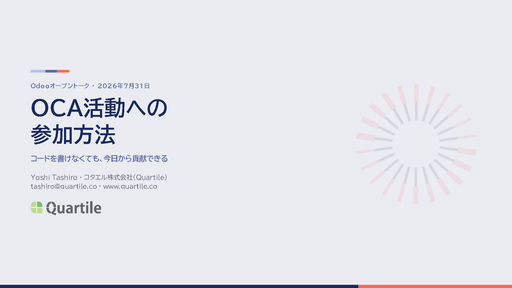
These slides are in Japanese. They were presented at an Odoo Open Talk held on 31 July 2026, and set out how to start contributing to the OCA (Odoo Community Association) — for people who write code and for people who don't.
The number of companies using Odoo in Japan has grown, but the number giving back to the ecosystem has not. This deck assumes that gap is not about willingness but about knowing where the entry points are, and aims to make the first step concrete.
What the deck covers
- What the OCA (Odoo Community Association) is — its relationship with Odoo S.A., and its AGPL/LGPL output
- Contribution is not only writing code — translation, issues, review, documentation
- Turn what troubles you into an issue — put it in the open instead of solving it internally
- The developer route — from signing the CLA to opening a small PR
- How a PR reaches merge, and how long that realistically takes
- A worked example: how a two-line PR progressed (OCA/account-invoicing#2201)
- Mistakes new contributors commonly make — opening translation PRs directly, and others
- Rules for contributing with AI — the OCA Generative AI / LLM Policy (effective July 2026)
- Beyond individual contribution — why company commitment is necessary
- Realistic entry points for the Japanese community
- Glossary
Links
- OCA repositories (GitHub)
- CLA (Contributor License Agreement)
- Weblate — the OCA translation platform
- OCA Generative AI / LLM Policy
- The PR used as the worked example: OCA/account-invoicing#2201
- OCA Days 2025 — Daniel Reis on how to contribute
- Unofficial Japanese Odoo community Discord
Links inside the slides are clickable once you download the PDF.
Odoo Overview / Know-how
View allThese slides are in Japanese. They were presented at an Odoo Open Talk held on 31 July 2026, and set out how to start contributing to the OCA (Odoo Community Association) — for people who write code and for people who don't.
The number of companies using Odoo in Japan has grown, but the number giving back to the ecosystem has not. This deck assumes that gap is not about willingness but about knowing where the entry points are, and aims to make the first step concrete.
What the deck covers
- What the OCA (Odoo Community Association) is — its relationship with Odoo S.A., and its AGPL/LGPL output
- Contribution is not only writing code — translation, issues, review, documentation
- Turn what troubles you into an issue — put it in the open instead of solving it internally
- The developer route — from signing the CLA to opening a small PR
- How a PR reaches merge, and how long that realistically takes
- A worked example: how a two-line PR progressed (OCA/account-invoicing#2201)
- Mistakes new contributors commonly make — opening translation PRs directly, and others
- Rules for contributing with AI — the OCA Generative AI / LLM Policy (effective July 2026)
- Beyond individual contribution — why company commitment is necessary
- Realistic entry points for the Japanese community
- Glossary
Links
- OCA repositories (GitHub)
- CLA (Contributor License Agreement)
- Weblate — the OCA translation platform
- OCA Generative AI / LLM Policy
- The PR used as the worked example: OCA/account-invoicing#2201
- OCA Days 2025 — Daniel Reis on how to contribute
- Unofficial Japanese Odoo community Discord
Links inside the slides are clickable once you download the PDF.
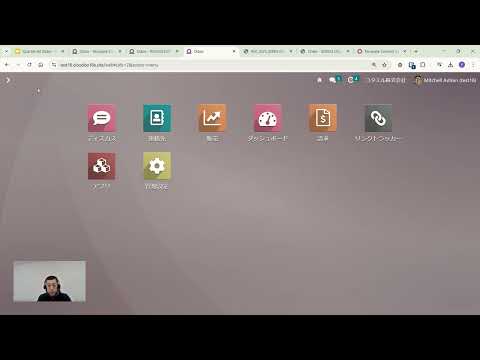
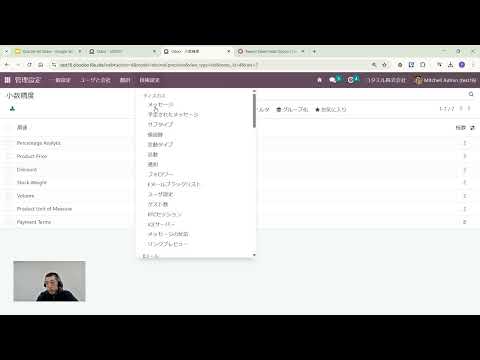
How to change the wording of a label on a printed report. This is part 5 of a five-part series on the recurring problems with Odoo's printed reports in Japan. The video is in Japanese.
The Odoo version used throughout is 16.0.
The problem addressed here
- a label needs different wording — for example shortening Salesperson to simply the person in charge
OCA module used
Other parts of the series
- Making Odoo's Printed Reports Work in Japan, Part 1 — Registration number and Japanese prefecture names
- Making Odoo's Printed Reports Work in Japan, Part 2 — Adding the honorifics Onchu and Sama
- Making Odoo's Printed Reports Work in Japan, Part 3 — Switching the layout to the Japanese convention
- Making Odoo's Printed Reports Work in Japan, Part 4 — Adjusting how unit prices and quantities are shown
Related links
How to adjust the displayed precision of unit prices and quantities. This is part 4 of a five-part series on the recurring problems with Odoo's printed reports in Japan. The video is in Japanese.
The Odoo version used throughout is 16.0.
The problem addressed here
- unit price and quantity fields print at a finer precision than needed, showing unwanted decimals
OCA module used
Other parts of the series
- Making Odoo's Printed Reports Work in Japan, Part 1 — Registration number and Japanese prefecture names
- Making Odoo's Printed Reports Work in Japan, Part 2 — Adding the honorifics Onchu and Sama
- Making Odoo's Printed Reports Work in Japan, Part 3 — Switching the layout to the Japanese convention
- Making Odoo's Printed Reports Work in Japan, Part 5 — Changing the wording of labels
Related links
Recruitment
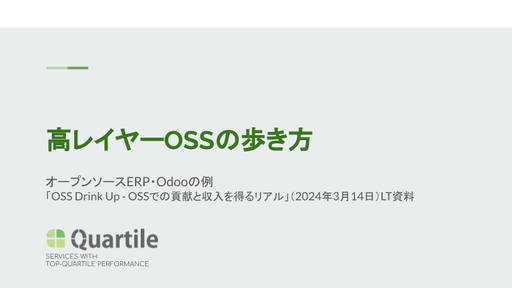
View allA lightning talk given at "OSS Drink Up — the reality of contributing to OSS and earning from it", held at Engineer Cafe on 14 March 2024. These slides are in Japanese. It approaches the question of making a living from OSS through the concrete case of Odoo.
The talk is about practice: how a very small IT services firm makes this work commercially.
What the deck covers
- What Odoo is — the most popular open source business application suite, highly extensible, broad in scope, and used by 12 million people
- Odoo's growth cycle, and the leverage open source provides within it
- How the open core model is structured — the free Community edition, the paid Enterprise edition, and the OCA module set as a third layer
- OCA by the numbers — 1,355 members, 231 repositories, and 5,458 modules as of February 2024
- Low-layer versus high-layer OSS — the former, like the Linux kernel and PostgreSQL, addresses technical problems and is funded by large technology companies; the latter, like Odoo and WordPress, addresses business problems and is funded by industry bodies, user companies, and consultancies
- How to compete in high-layer OSS — build OSS work into marketing, delivery, staff development, and your own internal systems, and do not sign away copyright in client contracts
- Whether it is safe to publish your know-how — the community helps back, market awareness rises, information asymmetry eases, and the ecosystem grows into somewhere proprietary-minded competitors cannot follow
- Quartile's work with Odoo, and the correlation between OSS involvement and service quality
Related links

Default channel for slides, all public users can access content of this channel.