Odoo Slides & Videos

Odoo Slides & Videos

Presentation decks and explainer videos that Quartile has used at events and webinars, covering Odoo implementation, customization, Japanese localization, and open source community work.

Last Update 08/02/2026
Completion Time 2 hours 31 minutes
Members 1
Odoo Overview / Know-how
View all
New Content
How to Get Involved in OCA Activities (Odoo Open Talk, July 2026 — slides in Japanese)
Preview

These slides are in Japanese. They were presented at an Odoo Open Talk held on 31 July 2026, and set out how to start contributing to the OCA (Odoo Community Association) — for people who write code and for people who don't.

The number of companies using Odoo in Japan has grown, but the number giving back to the ecosystem has not. This deck assumes that gap is not about willingness but about knowing where the entry points are, and aims to make the first step concrete.

What the deck covers

  • What the OCA (Odoo Community Association) is — its relationship with Odoo S.A., and its AGPL/LGPL output
  • Contribution is not only writing code — translation, issues, review, documentation
  • Turn what troubles you into an issue — put it in the open instead of solving it internally
  • The developer route — from signing the CLA to opening a small PR
  • How a PR reaches merge, and how long that realistically takes
  • A worked example: how a two-line PR progressed (OCA/account-invoicing#2201)
  • Mistakes new contributors commonly make — opening translation PRs directly, and others
  • Rules for contributing with AI — the OCA Generative AI / LLM Policy (effective July 2026)
  • Beyond individual contribution — why company commitment is necessary
  • Realistic entry points for the Japanese community
  • Glossary

Links

Links inside the slides are clickable once you download the PDF.

Odoo in Japan: Strengths, Challenges, and the OSS Question
Preview

Presented at the Odoo Partner Session on 24 June 2026. The deck sets out how far Odoo gets in the Japanese market, where it stalls, and the role open source plays in getting past that.

The slides are mainly in English, with Japanese alongside the key points.

What the deck covers

  • Why the playbook that worked globally stalls in Japan — Japanese UI and documentation are mandatory, the linguistic distance is large, processes bend to trading partners, commercial customs are distinctive, adoption decisions are cautious and precedent-driven, and domestic accounting and HR software is strong
  • The turning point — Odoo brought translation in-house in 2023 and the Japanese UI is now genuinely usable, awareness is rising, and AI is collapsing the language and implementation barrier
  • The state of OCA contribution — 448 of 3,300 partners contributed to OCA in 2024, and as the partner count passes 16,000 that share keeps shrinking
  • Three asks of Odoo S.A. — recognise the partners who contribute, collaborate on Japanese localization instead of duplicating it, and teach new partners the norms of open source
  • What breaks the virtuous cycle — free-riding on OCA, treating "open" as marketing rather than practice, localization lag eroding satisfaction, and losing differentiation into price competition
  • Why a healthy OSS ecosystem serves Odoo S.A.'s own business — lower acquisition cost, faster product improvement, and stronger partners

Related links

Why Take Part in Odoo's Open Source Community (Part 1: The Why)
Preview

Used at an Odoo Open Talk in June 2024. These slides are in Japanese. Before telling anyone to contribute, the deck explains how the Odoo ecosystem actually turns and why it needs more participants right now.

This session is about background and reasoning rather than procedure.

What the deck covers

  • Odoo's history and licence changes — from TinyERP to OpenERP to Odoo, through GPL and AGPL, and the move to an LGPL-plus-proprietary open core model in October 2015
  • Why the shift to open core happened — under AGPL the vendor struggled to secure revenue and had to lean on selling services
  • How the licences differ — LGPLv3 lets proprietary features sit on top; AGPLv3 extends to dependent code and requires source to be obtainable
  • Odoo's growth cycle — product improvement, user base, monetisation, and reinvestment, with open source acting as the leverage
  • Who is in the ecosystem — Odoo S.A., partners, other service providers, OSS contributors, and users, and how each connects
  • How Odoo's focus changed — after the open core shift, the sales side of the business inevitably grew louder
  • The present concern — many market-facing staff and partners appear indifferent to the OSS ecosystem, and newly joining partners do not take part in it
  • The worst case for users — roughly 60% of user requirements can be met with existing OCA modules, so if that ecosystem dies the answer reverts to bespoke proprietary development
  • Reasons to take part, set against the reasons people give for not taking part
  • What anyone can do first — use a community module, tell your users you are using it, and write about it publicly

Related links

Recruitment
View all
Navigating High-Layer OSS — Building a Business on Open Source ERP
Preview

A lightning talk given at "OSS Drink Up — the reality of contributing to OSS and earning from it", held at Engineer Cafe on 14 March 2024. These slides are in Japanese. It approaches the question of making a living from OSS through the concrete case of Odoo.

The talk is about practice: how a very small IT services firm makes this work commercially.

What the deck covers

  • What Odoo is — the most popular open source business application suite, highly extensible, broad in scope, and used by 12 million people
  • Odoo's growth cycle, and the leverage open source provides within it
  • How the open core model is structured — the free Community edition, the paid Enterprise edition, and the OCA module set as a third layer
  • OCA by the numbers — 1,355 members, 231 repositories, and 5,458 modules as of February 2024
  • Low-layer versus high-layer OSS — the former, like the Linux kernel and PostgreSQL, addresses technical problems and is funded by large technology companies; the latter, like Odoo and WordPress, addresses business problems and is funded by industry bodies, user companies, and consultancies
  • How to compete in high-layer OSS — build OSS work into marketing, delivery, staff development, and your own internal systems, and do not sign away copyright in client contracts
  • Whether it is safe to publish your know-how — the community helps back, market awareness rises, information asymmetry eases, and the ecosystem grows into somewhere proprietary-minded competitors cannot follow
  • Quartile's work with Odoo, and the correlation between OSS involvement and service quality

Related links

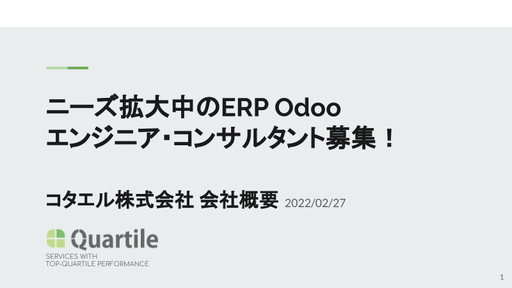
Quartile Corporation Company Overview — Odoo Engineer and Consultant Recruiting (February 2022)
Preview

Slides used at Fukuoka Prefecture's online joint recruiting event for IT roles on 27 February 2022. These slides are in Japanese. They cover how Quartile came about, what the business does, and what the Odoo engineer and consultant roles involve.

The content reflects February 2022. For current headcount and hiring terms, please see the careers page.

What the deck covers

  • About Quartile — founded in Hong Kong as Quartile Limited in 2012, with Quartile Corporation established in Fukuoka in August 2018, led by Yoshi Tashiro
  • What Odoo is — the most widely used open source business application suite, where combining standard features with community modules covers a wide range of needs at low cost
  • Odoo implementations delivered by Quartile, and how projects are approached and scheduled
  • The services offered and the track record in add-on development
  • What the work at Quartile actually looks like
  • Why the roles are open, who they are for, and the terms on offer
  • How the hiring process runs

Related links

Default channel for slides, all public users can access content of this channel.