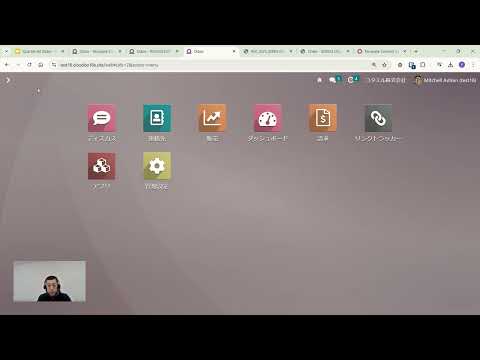
Odoo Slides & Videos
Presentation decks and explainer videos that Quartile has used at events and webinars, covering Odoo implementation, customization, Japanese localization, and open source community work.
| Last Update | 08/02/2026 |
|---|---|
| Completion Time | 2 hours 31 minutes |
| Members | 1 |
Share This Course
Share Link
Share on Social Media
Share by Email
Please login to share this Odoo Slides & Videos by email.
Presented at the Odoo Partner Session on 24 June 2026. The deck sets out how far Odoo gets in the Japanese market, where it stalls, and the role open source plays in getting past that.
The slides are mainly in English, with Japanese alongside the key points.
What the deck covers
- Why the playbook that worked globally stalls in Japan — Japanese UI and documentation are mandatory, the linguistic distance is large, processes bend to trading partners, commercial customs are distinctive, adoption decisions are cautious and precedent-driven, and domestic accounting and HR software is strong
- The turning point — Odoo brought translation in-house in 2023 and the Japanese UI is now genuinely usable, awareness is rising, and AI is collapsing the language and implementation barrier
- The state of OCA contribution — 448 of 3,300 partners contributed to OCA in 2024, and as the partner count passes 16,000 that share keeps shrinking
- Three asks of Odoo S.A. — recognise the partners who contribute, collaborate on Japanese localization instead of duplicating it, and teach new partners the norms of open source
- What breaks the virtuous cycle — free-riding on OCA, treating "open" as marketing rather than practice, localization lag eroding satisfaction, and losing differentiation into price competition
- Why a healthy OSS ecosystem serves Odoo S.A.'s own business — lower acquisition cost, faster product improvement, and stronger partners
Related links

Odoo Overview / Know-how
View allPresented at the Odoo Partner Session on 24 June 2026. The deck sets out how far Odoo gets in the Japanese market, where it stalls, and the role open source plays in getting past that.
The slides are mainly in English, with Japanese alongside the key points.
What the deck covers
- Why the playbook that worked globally stalls in Japan — Japanese UI and documentation are mandatory, the linguistic distance is large, processes bend to trading partners, commercial customs are distinctive, adoption decisions are cautious and precedent-driven, and domestic accounting and HR software is strong
- The turning point — Odoo brought translation in-house in 2023 and the Japanese UI is now genuinely usable, awareness is rising, and AI is collapsing the language and implementation barrier
- The state of OCA contribution — 448 of 3,300 partners contributed to OCA in 2024, and as the partner count passes 16,000 that share keeps shrinking
- Three asks of Odoo S.A. — recognise the partners who contribute, collaborate on Japanese localization instead of duplicating it, and teach new partners the norms of open source
- What breaks the virtuous cycle — free-riding on OCA, treating "open" as marketing rather than practice, localization lag eroding satisfaction, and losing differentiation into price competition
- Why a healthy OSS ecosystem serves Odoo S.A.'s own business — lower acquisition cost, faster product improvement, and stronger partners
Related links

How to change the wording of a label on a printed report. This is part 5 of a five-part series on the recurring problems with Odoo's printed reports in Japan. The video is in Japanese.
The Odoo version used throughout is 16.0.
The problem addressed here
- a label needs different wording — for example shortening Salesperson to simply the person in charge
OCA module used
Other parts of the series
- Making Odoo's Printed Reports Work in Japan, Part 1 — Registration number and Japanese prefecture names
- Making Odoo's Printed Reports Work in Japan, Part 2 — Adding the honorifics Onchu and Sama
- Making Odoo's Printed Reports Work in Japan, Part 3 — Switching the layout to the Japanese convention
- Making Odoo's Printed Reports Work in Japan, Part 4 — Adjusting how unit prices and quantities are shown
Related links
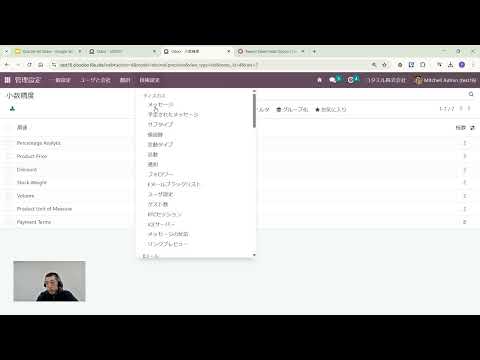
How to adjust the displayed precision of unit prices and quantities. This is part 4 of a five-part series on the recurring problems with Odoo's printed reports in Japan. The video is in Japanese.
The Odoo version used throughout is 16.0.
The problem addressed here
- unit price and quantity fields print at a finer precision than needed, showing unwanted decimals
OCA module used
Other parts of the series
- Making Odoo's Printed Reports Work in Japan, Part 1 — Registration number and Japanese prefecture names
- Making Odoo's Printed Reports Work in Japan, Part 2 — Adding the honorifics Onchu and Sama
- Making Odoo's Printed Reports Work in Japan, Part 3 — Switching the layout to the Japanese convention
- Making Odoo's Printed Reports Work in Japan, Part 5 — Changing the wording of labels
Related links
Default channel for slides, all public users can access content of this channel.