
What comes to mind when you hear the word "ERP"?
Expensive. Complicated. Hard to use. Not for small and medium-sized companies.
That image may have set firm in Japan.
Around 2000, when ERP was becoming widely known in Japan, I worked as an ERP consultant on several ERP package implementations. Then, as SaaS spread rapidly through the 2010s, I used a number of SaaS products myself from the back-office side.
Having been on both sides, I find that Odoo is a very unusual ERP — not like the ERPs that came before it, and not like a standalone SaaS product either.
This post is written for someone who does not know Odoo at all, and takes
- what ERP is
- why ERP has been such a high hurdle for small and medium-sized companies
- and what is different about Odoo
as plainly as it can.
What ERP is (and why it was hard)
ERP (Enterprise Resource Planning) is
a way of managing a company's core operations — accounting, sales, purchasing, inventory, manufacturing, HR and the rest — in one integrated system.
Around 2000, ERP drew attention as "best practice" and many large companies adopted it. At the same time, though,
- the cost of implementation comes out higher than expected
- implementation takes a long time
- you have to fit the way you work to the system
- it is hard to use
stories like these spread as well, and the image of ERP as hard work, and easy to fail at took hold.
Among small and medium-sized companies in particular,
"we put in an ERP that was out of proportion to us, and the load on the floor went up"
— cases like that are said to have been far from rare.
Systems in small companies now have a different problem
Time has moved on, and there are now a great many SaaS products.
Sales management, invoicing, expenses, attendance, HR……
Putting an individual business function on a system has become far easier than it used to be.
At the same time, though, problems like these are appearing on the floor at small companies.
- the same information is entered into several systems
- user and permission management is scattered, which makes security uncomfortable
- as more SaaS is added, the monthly total quietly grows into a large sum
- even for a small function, the selection process takes time
- nobody holds the whole picture
- even after a system is replaced, the same awkwardness as before is still there
The result of using more and more convenient SaaS is that the work itself has been cut into pieces.
Where are we, in the three stages of DX?
DX (digital transformation) is often explained in the following three stages.
- "Digitisation", making paper work digital
- "Digitalisation", making the whole business flow digital
- "DX", changing the business model using digital
For many small and medium-sized companies,
it is far from rare to have stopped somewhere in the middle of ① and ②.
What matters here is
a system where the whole of the work is connected.
Odoo is an ERP you can start on easily
Odoo is an ERP for small and medium-sized companies.
Compared with an enterprise ERP such as SAP, what stands out is how surprisingly low the barrier to getting started is.
- there is little configuration to do up front
- default settings come ready
- you can put your hands on it and try it first
With Odoo you set the language, the company and the users, and from there you can run it and deepen your understanding as you go.
A typical enterprise ERP has a very large number of settings, and a great deal can be achieved through parameters alone — but the other side of that is having to configure, one by one, that you are not using the features you do not use. So the analysis and configuration take time during implementation, and master maintenance afterwards tends to be laborious as well.
Take manufacturing cost accounting: SAP has sophisticated features that collect and allocate overhead and calculate unit costs automatically, but they call for complex masters and parameters and a large volume of data entry.
In Odoo, the manufacturing cost is worked out
as "the material unit cost registered on the bill of materials × the quantity" plus "the unit cost set for each work centre × the working time"
— that simple a calculation.
So where you want strict cost accounting, there are cases where SAP is the better fit.
Getting an accurate cost, though, takes a great deal of work in practice.
Electricity alone means measuring the office's consumption separately from the factory's, and collecting the running hours and power draw of each machine tool. Assembling all of that takes real money and effort.
So how strictly the cost really needs to be managed is a question of balancing the effort put in against the effect obtained, and that balance is what matters.
Odoo is an ERP for small and medium-sized companies and its features are simple. In exchange, it is an ERP you can start using easily.
Why you can start small
Because Odoo's functionality is divided into modules, or apps,
only the fields belonging to what you have installed are displayed.
For instance,
- if you use only the Invoicing app, the master fields on a product and elsewhere are kept to a minimum
- when you add Sales and Purchase later, the fields you need for them appear
That is the shape of it.
It may be easier to see it on an actual Odoo screen.
The example below is the product master screen with only the Invoicing app enabled.
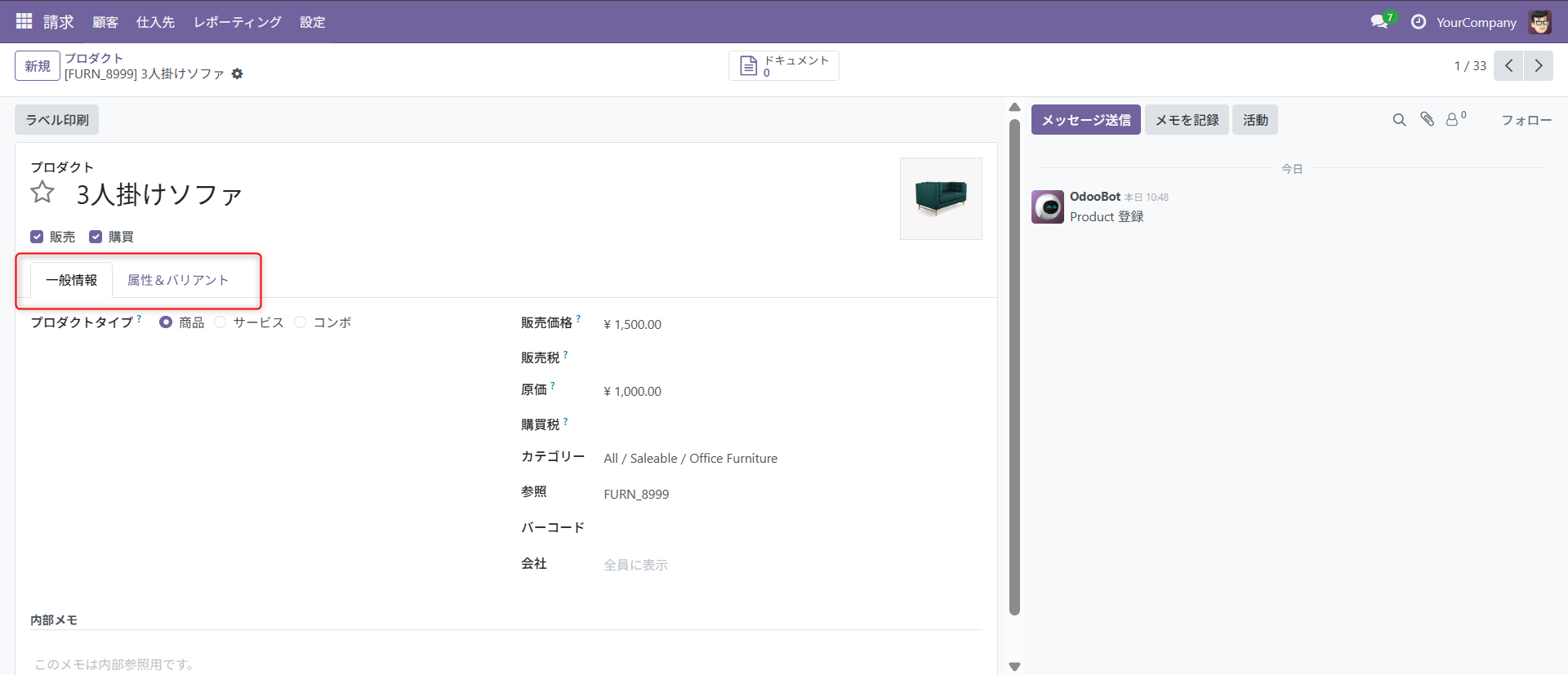
Below is the product master screen with Manufacturing, Sales, Purchase and Point of Sale enabled as well as Invoicing. You can see that the tabs and fields belonging to the enabled apps have multiplied.
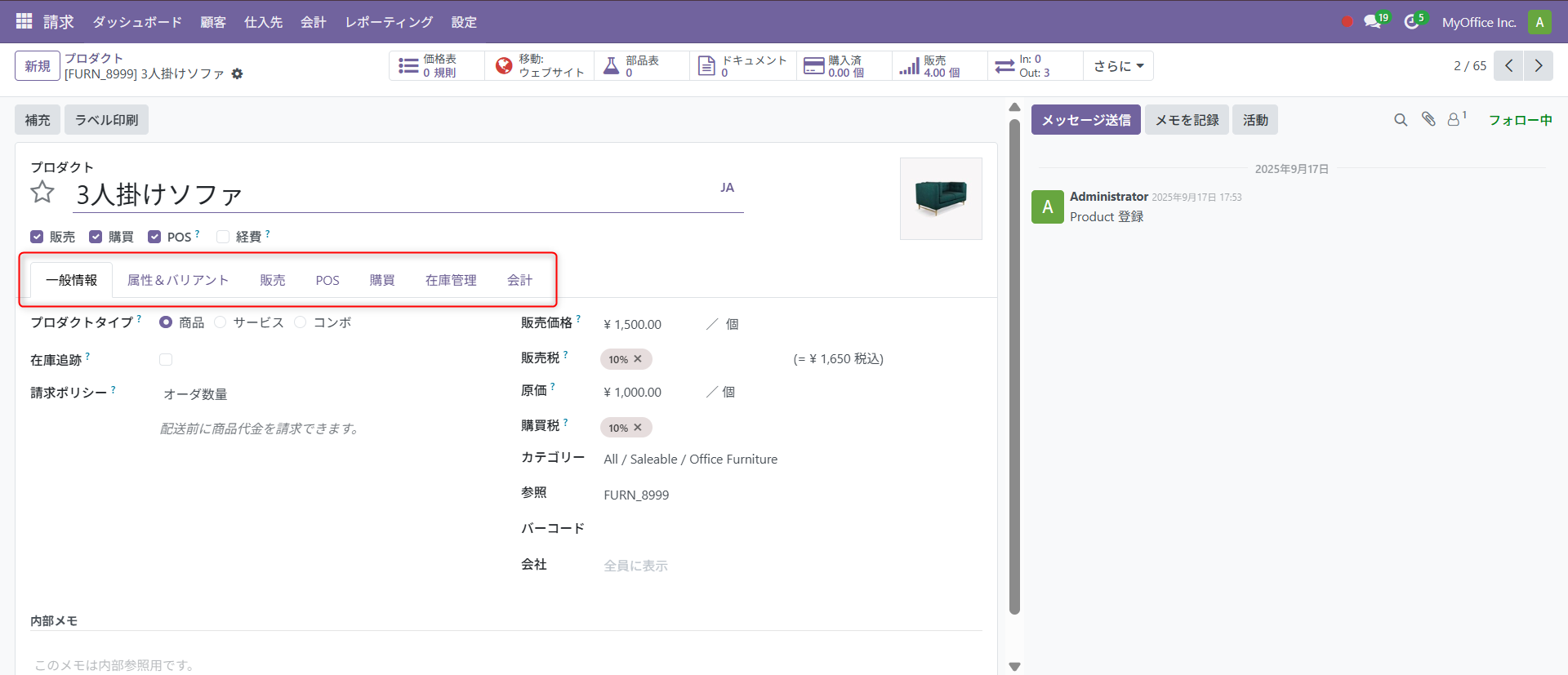
"You do not have to think about all of it from the start"
That is a big part of what Odoo is.
Taking the best of SaaS and the best of ERP
Odoo
is less a rigid ERP than an integrated business system of SaaS parts wired together
— that is the description that fits it.
- each function is naturally connected to the next
- you do not enter the same data in several places
- the screens are web-based and easy to follow
It has the lightness of SaaS along with the coherence and integration of an ERP.
An ERP you do not have to replace everything for
With ERP, the thought that
"there is no point unless every business system is replaced"
is one people tend to have.
With Odoo, though, there is real value in adopting it for part of the business only.
For example,
- manufacturing stays on the existing system
- invoicing, accounting, HR and the surrounding functions are gathered into Odoo
A way of using it like that is realistic.
In manufacturing especially, links with suppliers and customers are often already built in,
and it is far from rare for "tidying up and integrating" to be worth more than "replacing everything".
How Odoo is evolving, and what comes next
Odoo is upgraded every year, with
- stronger AI features
- integration with IoT and RFID
- improvements to the UI
and more, continuously.
Upgrading regularly lets you take new technology and new features into the way you work, so you might call it an ERP where DX moves forward without your having to think about it.
Odoo's problems, honestly
There are problems too, of course.
- there are places where the Japanese reads unnaturally
- there are places that do not fit business practice specific to Japan
These are also a side of being an ERP made outside Japan. Odoo has been working on the Japanese market over the past few years, so this is somewhere we expect further progress as well.
The strength of open source and the OCA
Odoo is an open-core ERP,
supported by a worldwide community called the OCA (Odoo Community Association).
Support for Japanese business practice, and the features you need in day-to-day work, are continually filled in and improved by that community.
That is a large reassurance: an ERP that is not left to a vendor.
Please see this blog post for the details.
The best thing is to try it
Your impression of Odoo changes a great deal once you actually put your hands on it.
"Is an ERP really this light?"
Plenty of people react that way.
Have a look at the posts below and give it a try.
How to try Odoo and how to install it
https://www.quartile.co/blog/odoo-1/odoo-68
How to set up an Odoo environment on a Windows PC, step by step
https://www.quartile.co/blog/odoo-1/windowsodoo-by-119
The basic configuration of Odoo V14.0
https://www.quartile.co/blog/odoo-1/odoov14-0-70
The basic common operations in Odoo V14.0
https://www.quartile.co/blog/odoo-1/odoov14-0-71
How to import data into Odoo
In summary: Odoo is “the right size of ERP for a small company today”
For a small or medium-sized company troubled both by
- the weight of an ERP
- and the fragmentation of SaaS
Odoo is a realistic option, and one you can keep going with.
"Start small, and grow it as the need comes"
If that is the kind of ERP you are looking for, Odoo is one we would like you to know about.
Photo by ThisisEngineering on Unsplash
What is Odoo? What kind of ERP is it?