
Odoo Experience 2026 was held in Brussels, Belgium, from 24 to 26 September 2026.
On day three, Odoo CEO Fabien Pinckaers gave the keynote session “Master Class: Hyperscale & Company Culture”.
The session covered how Odoo has grown, the management principles and company culture it holds to while growing this fast, and the impact of AI on society and business.
Much of it overlapped with last year's session, so this post focuses on what stood out most in the 2026 talk.
Last year's talk is covered in this post. It is useful background for understanding how Odoo is run, so if you have not read it yet, please take a look.
Odoo Experience 2025 Keynote - hyperscale growth and company culture
The video of the talk is here.
Odoo's rapid growth
Fabien Pinckaers founded Odoo in 2002.
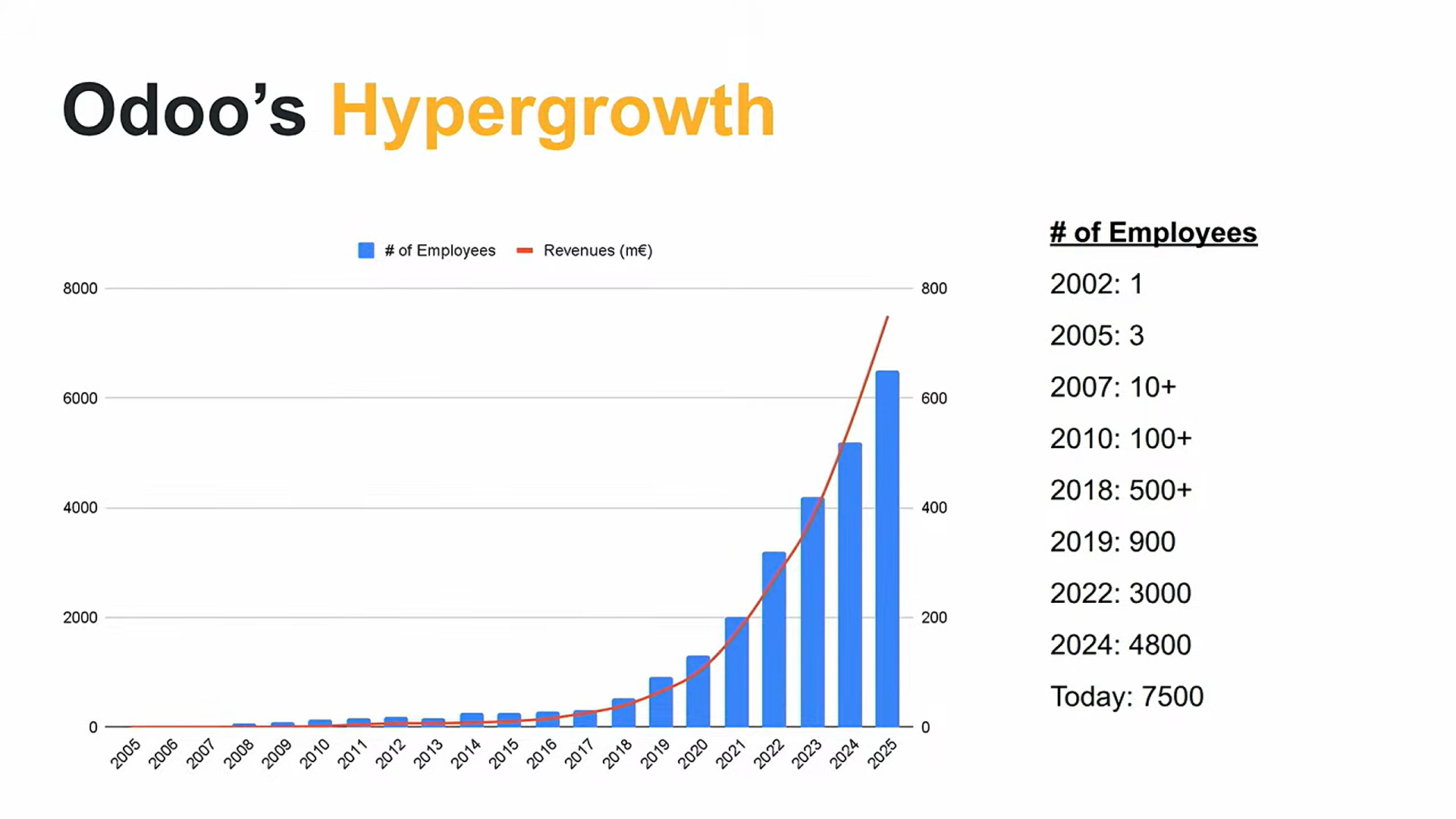
The talk showed how headcount and revenue have grown since then.
Employees: about 7,500 (at the time of the talk)
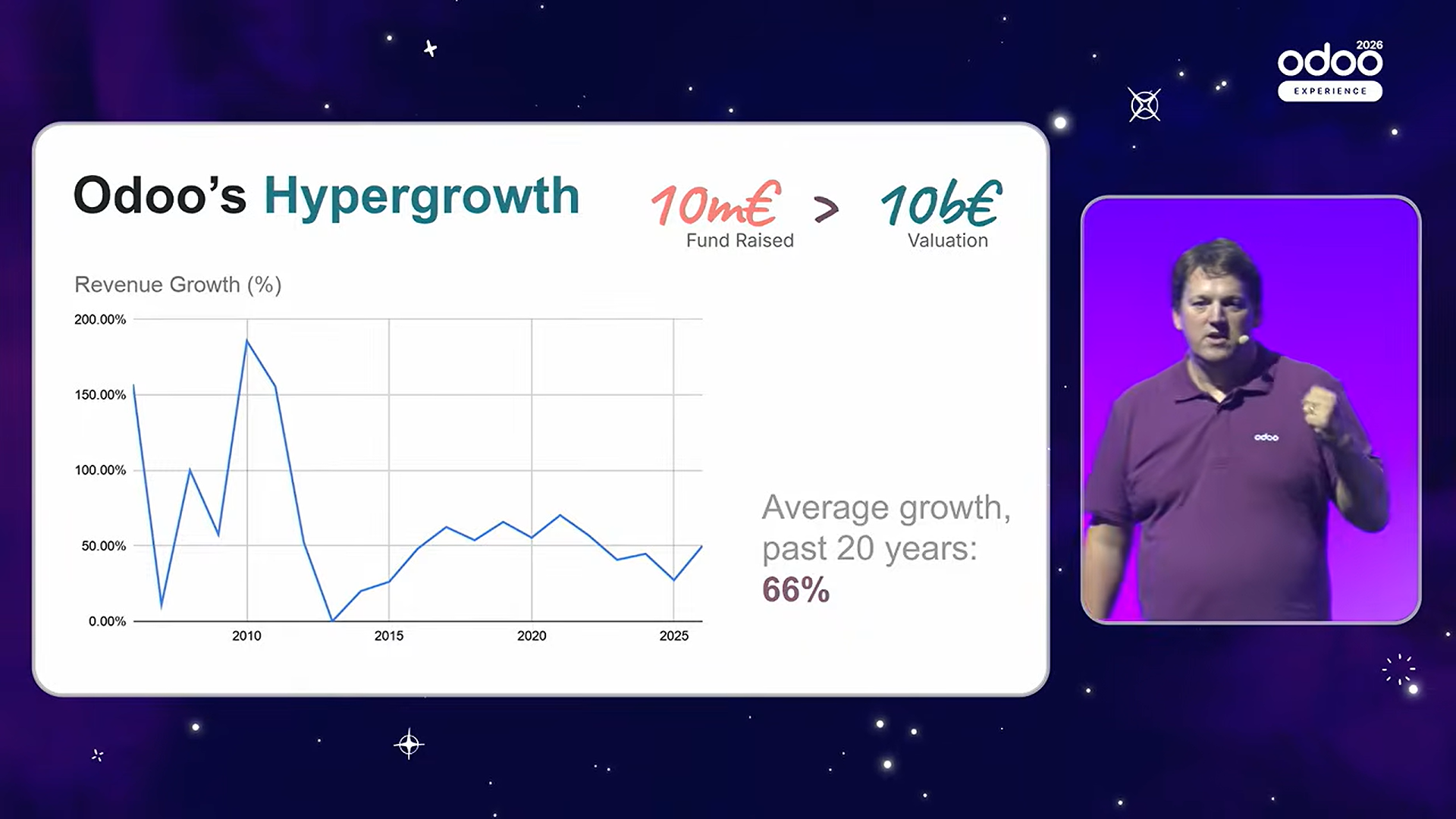
Average annual revenue growth over the past 20 years: 66%
Even as the company has grown this fast, Fabien explained that he spends more than half of his working time on product research and development.
As a company grows, its CEO's work tends to drift towards fundraising and external relations. Fabien, though, spends 95% of his time inside the company, on R&D and other internal work and communication, and still keeps the product at the centre of how Odoo is run.
How to approach AI
This talk looked at AI from a different angle from the new-feature presentations.
With so much attention on what AI can do, using AI can become a goal in itself. What Fabien stressed was to start from a real business problem.
Whether AI is the right tool for solving it is a decision for afterwards.
You cannot build a large building on AI
The talk compared AI, memorably, to sand.
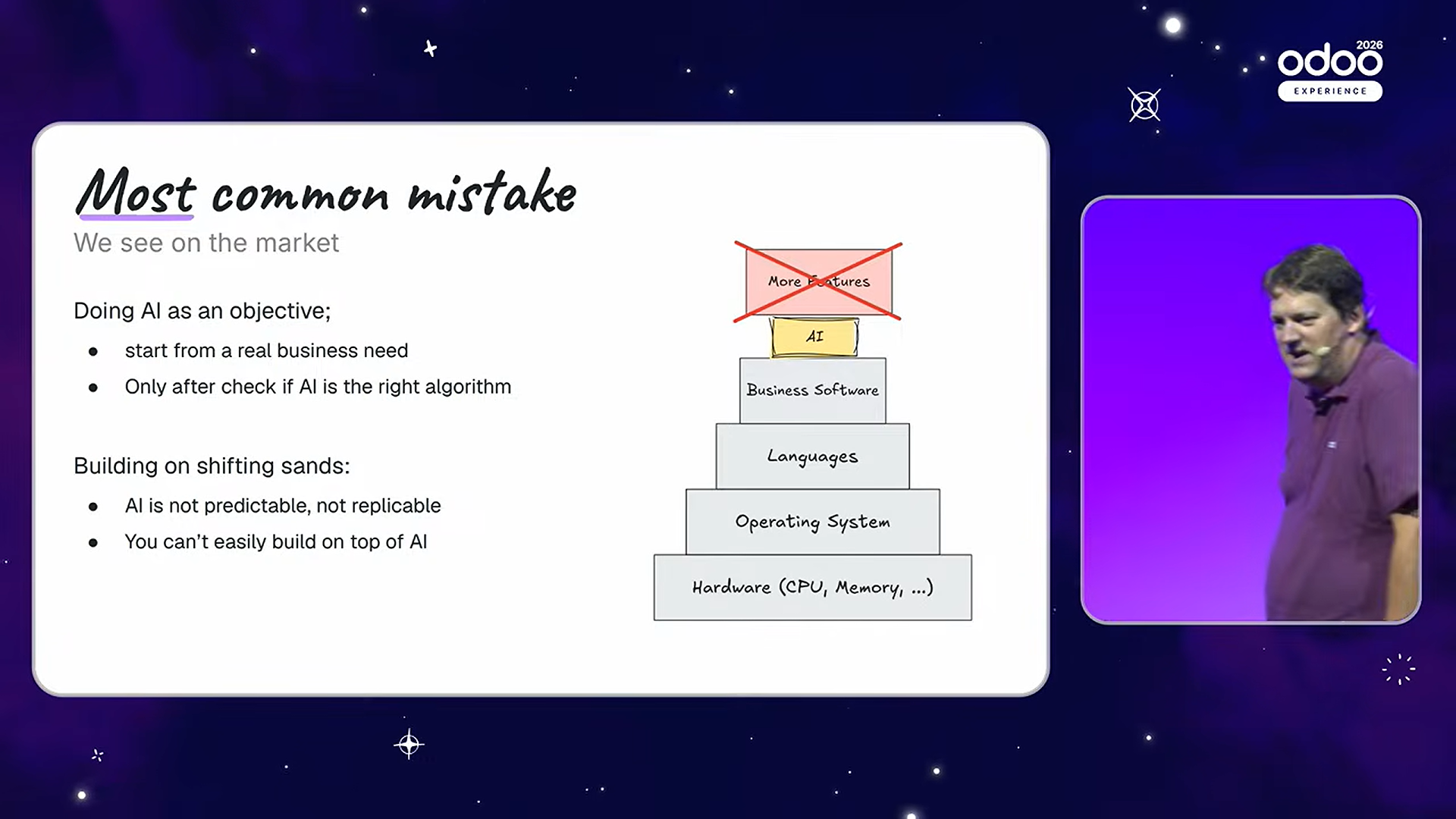
AI works on probabilities, so the same input does not always give exactly the same result. Results can be hard to predict, and reproducibility can be hard to guarantee.
Building large, critical systems on top of something with these properties is a risk.
Just as you cannot put a building on sand, you cannot build a large system on AI.
The point is to understand what AI is like, and to judge where it is the right thing to use.
For example, AI can be built into an existing development process with development tools such as Claude Code. But he said we should be wary of building the systems a business rests on in full reliance on AI output.
However far AI technology and models advance, business software has to be reliable and stable. Innovation has to continue in the foundations of the software too.
Why Odoo is well placed for the AI era
The talk gave two reasons why Odoo is well placed for the AI era.
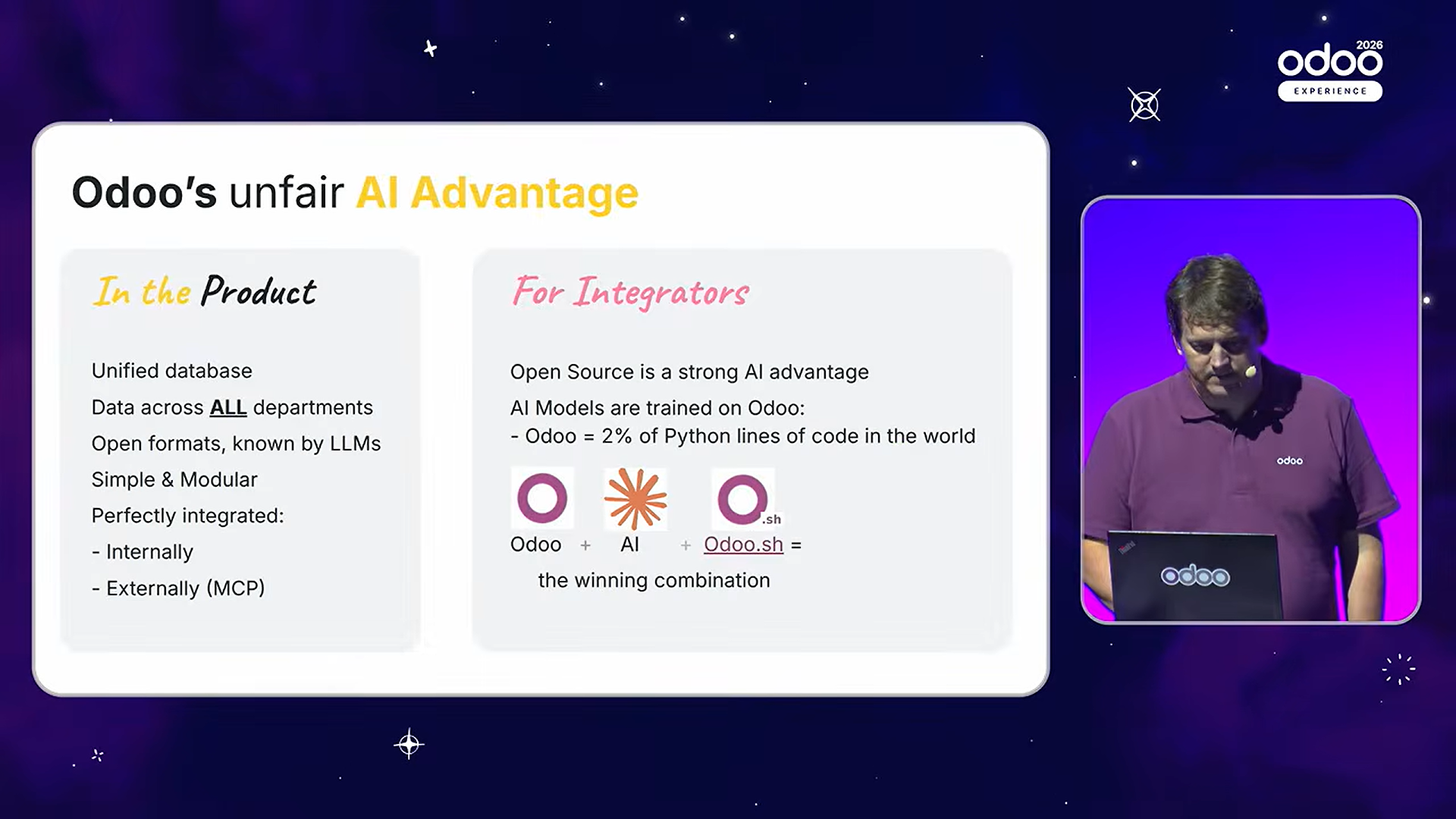
- Its business data is integrated. AI can draw on sales, purchasing, inventory and other information across the business, which makes it easier to give support that takes the whole operation into account.
- It is open source. Because the source code can be read, development and customization with AI are easier.
Together, these give Odoo an advantage on two fronts, beyond simply adding AI features: AI that makes use of business data, and more efficient development with AI.
Before adopting AI, sort out your IT
When you think about using AI, what matters is not only how good the AI is but also the IT around it.
In many companies, adopting a different IT tool for each part of the business has left a sprawl of systems and scattered data. It is natural for such a company to hope that AI will clear up all that complexity in one go.
But adopting AI does not solve every problem on its own.
When data is spread across several systems and business processes have not been sorted out, AI may be unable to get the right information, and the results may fall short of what was hoped.
First sort out your IT and put your business processes and data in order. Then use AI on top of that.
Rather than making the adoption of AI the goal, get the foundation of processes and data in place, then work out how AI can actually improve the work. The order matters.
How will AI change society and work?
At the end of the talk, he also touched on the impact of AI on society and employment.
Technological progress, from the mechanisation of farming to the Industrial Revolution and the IT revolution, has always changed the way people work. AI is another technology that changes how work is done and what skills are needed.
Some jobs will be automated by AI, but new jobs and roles may also appear. What matters is to think about how the work itself will change, rather than to see technological change simply as a loss of jobs.
Fabien gave Odoo's own growth as an example.
Progress in technology, AI included, can be used not only to cut staff but also to raise the quality and reach of a service.
In fact, as customer demand has grown and the use of its services has spread, Odoo has not shrunk its teams; it has grown them.
Summary: AI will not solve everything
As of 2026, AI is one of the most important management issues for many companies. Quite a few believe that how they use AI will decide how competitive they are.
We had expected this Odoo Experience to make a big pitch for new features and the possibilities of AI. In fact the talk was surprisingly measured: it did not only stress what AI can do, but also looked at its limits and at what has to be in place before using it.
AI will not solve everything. Rather than adopting a technology unconditionally because it is new, start from a real business problem, and use AI once a reliable software foundation is in place. That stance made a strong impression.
Precisely because AI is advancing so fast, it matters not only to chase new technology but to be clear about what you want to solve and what you want your own strengths to be.
Odoo Experience 2026 Keynote - hyperscale growth and company culture