Odoo Slides & Videos
Presentation decks and explainer videos that Quartile has used at events and webinars, covering Odoo implementation, customization, Japanese localization, and open source community work.
| Last Update | 08/02/2026 |
|---|---|
| Completion Time | 2 hours 31 minutes |
| Members | 1 |
Share This Course
Share Link
Share on Social Media
Share by Email
Please login to share this Odoo Slides & Videos by email.
Odoo Overview / Know-how
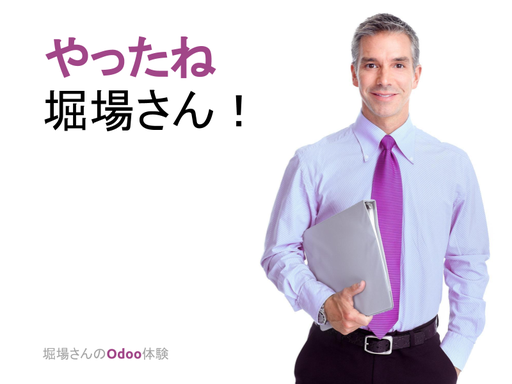
View allA Japanese adaptation of an illustrated Odoo introduction created in 2015. These slides are in Japanese. With almost no jargon, it follows in story form what happens when a business consolidates onto one system.
A good first thing to show someone new to Odoo, or a colleague you need to bring along internally.
The story
- Mr. Horiba runs an audio equipment manufacturer. With 45 staff handling 4,500 orders a day, the business ran at 100 orders per person
- Mr. Saito, the finance director, is buried in invoices raised from the logistics system, timesheet imports, refunds, reports for the boss, syncing the online shop, and payment runs
- Over a few years, separate IT tools piled up one after another, leaving the work more complex and still disconnected
- By 2015 headcount had reached 90, yet orders stalled at 5,000 a day. That is 55 per person — a 45% fall in five years — and margins fell with it
- When the HR director asks for recruitment software, Mr. Horiba balks at adding yet another system
- Wanting to consolidate the sprawl, he encounters Odoo and starts small with the recruitment app alone
- As CRM, manufacturing, sales, BI, project, and accounting follow, orders per person climb back from 55 step by step while annual IT cost falls from its starting point of 7.5 million yen
Related links
Presented at the Odoo Roadshow in Tokyo on 23 March 2018, the first such event held in Japan. These slides are in Japanese. Across 78 pages it covers what kind of product Odoo is and how its being open source bears on an implementation.
The material reflects March 2018. Figures and screens differ from current versions, but the thinking on how to use open source and how to choose a partner still holds.
What the deck covers
- Odoo's market position — search trend comparisons against the major ERPs, and against other open source ERPs
- Why Odoo became popular worldwide — low cost, broad functional coverage, and global capability
- The growth cycle of an open source product — and why Odoo turns that cycle more successfully than any other open source ERP
- Characteristics of the Japanese market — Japanese material and a Japanese UI are mandatory, commercial customs are distinctive, and failure is avoided
- What open source is, and what it offers users, service providers, and the vendor respectively
- Routes to implementation — engaging a partner versus doing it yourself
- Why the Odoo Community Association exists, with a breakdown of module counts by version
- An introduction to Quartile and the community work it does
- Customization examples — extra fields captured at purchase registration, pulling records from the supplier table, auto-archiving out-of-stock web products, and bulk-importing auction results
- Feedback from an implementation customer, and why the choice of partner matters so much
Related links
Used at an Odoo Open Talk in June 2024. These slides are in Japanese. Before telling anyone to contribute, the deck explains how the Odoo ecosystem actually turns and why it needs more participants right now.
This session is about background and reasoning rather than procedure.
What the deck covers
- Odoo's history and licence changes — from TinyERP to OpenERP to Odoo, through GPL and AGPL, and the move to an LGPL-plus-proprietary open core model in October 2015
- Why the shift to open core happened — under AGPL the vendor struggled to secure revenue and had to lean on selling services
- How the licences differ — LGPLv3 lets proprietary features sit on top; AGPLv3 extends to dependent code and requires source to be obtainable
- Odoo's growth cycle — product improvement, user base, monetisation, and reinvestment, with open source acting as the leverage
- Who is in the ecosystem — Odoo S.A., partners, other service providers, OSS contributors, and users, and how each connects
- How Odoo's focus changed — after the open core shift, the sales side of the business inevitably grew louder
- The present concern — many market-facing staff and partners appear indifferent to the OSS ecosystem, and newly joining partners do not take part in it
- The worst case for users — roughly 60% of user requirements can be met with existing OCA modules, so if that ecosystem dies the answer reverts to bespoke proprietary development
- Reasons to take part, set against the reasons people give for not taking part
- What anyone can do first — use a community module, tell your users you are using it, and write about it publicly
Related links
Recruitment
View allSlides used at Fukuoka Prefecture's online joint recruiting event for IT roles on 27 February 2022. These slides are in Japanese. They cover how Quartile came about, what the business does, and what the Odoo engineer and consultant roles involve.
The content reflects February 2022. For current headcount and hiring terms, please see the careers page.
What the deck covers
- About Quartile — founded in Hong Kong as Quartile Limited in 2012, with Quartile Corporation established in Fukuoka in August 2018, led by Yoshi Tashiro
- What Odoo is — the most widely used open source business application suite, where combining standard features with community modules covers a wide range of needs at low cost
- Odoo implementations delivered by Quartile, and how projects are approached and scheduled
- The services offered and the track record in add-on development
- What the work at Quartile actually looks like
- Why the roles are open, who they are for, and the terms on offer
- How the hiring process runs
Related links

A lightning talk given at "OSS Drink Up — the reality of contributing to OSS and earning from it", held at Engineer Cafe on 14 March 2024. These slides are in Japanese. It approaches the question of making a living from OSS through the concrete case of Odoo.
The talk is about practice: how a very small IT services firm makes this work commercially.
What the deck covers
- What Odoo is — the most popular open source business application suite, highly extensible, broad in scope, and used by 12 million people
- Odoo's growth cycle, and the leverage open source provides within it
- How the open core model is structured — the free Community edition, the paid Enterprise edition, and the OCA module set as a third layer
- OCA by the numbers — 1,355 members, 231 repositories, and 5,458 modules as of February 2024
- Low-layer versus high-layer OSS — the former, like the Linux kernel and PostgreSQL, addresses technical problems and is funded by large technology companies; the latter, like Odoo and WordPress, addresses business problems and is funded by industry bodies, user companies, and consultancies
- How to compete in high-layer OSS — build OSS work into marketing, delivery, staff development, and your own internal systems, and do not sign away copyright in client contracts
- Whether it is safe to publish your know-how — the community helps back, market awareness rises, information asymmetry eases, and the ecosystem grows into somewhere proprietary-minded competitors cannot follow
- Quartile's work with Odoo, and the correlation between OSS involvement and service quality
Related links
Default channel for slides, all public users can access content of this channel.