
From the AGPL to the LGPL
If you follow how Odoo is doing you will already know that from v9 Odoo split into an open-source Community edition and an Enterprise edition carrying the paid features. With that split, the Community edition's licence also moved from the AGPL, which had applied up to v8, to the LGPL instead.
The AGPL is regarded as the most strongly copyleft of the open-source licences. It obliges you to disclose your source code to your users, and a program that depends on AGPL code must be AGPL as well.
The LGPL, by contrast, was drawn up in the first place for libraries meant to be used by programs of every kind. It is an open-source licence, but its copyleft is not as strong as the AGPL's: a program that links to an LGPL program is allowed to keep its own source closed.
What was behind the licence change
The direct reason for the change is a change in Odoo S.A.'s business model: making it possible to charge for the Enterprise edition and for other paid modules.
To see why, you need to know how the Community and Enterprise editions relate to each other. What the Enterprise edition contains is the Community edition plus a set of paid modules, and roughly speaking the Community edition is the core features while the paid modules are what strengthens those core features. Put the other way round, the paid modules depend on the core features, which are the Community edition. Given that relationship, the AGPL stands in the way of a model that charges for the Enterprise edition: under the AGPL there is an obligation to disclose the source, so charging for the software itself does not work in practice. A program depending on LGPL source is under no obligation to be open source and can be kept closed, which suited Odoo S.A.'s change of charging model well.
The licence constraints that follow from taking LGPL source as the core are summed up neatly in the diagram below.
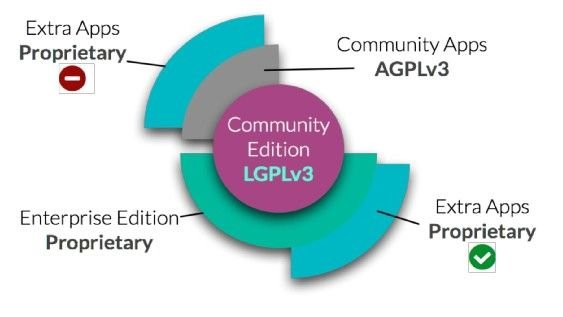
Odoo S.A. also had a concern of its own, which was to build up the app platform that offers every kind of Odoo module, third-party paid modules included. There are several thousand community modules in total, the argument ran, but quality and documentation have not kept pace with that volume. Clearing that up means raising developers' incentives, and the way to do it is to allow modules that cost money but come with assured quality.
Will the community turn away?
Odoo S.A., which had until then held that its revenue would come from services, has turned towards taking revenue from the product as well, and the run of moves that included the licence change drew strongly worded concern from many community members. Among the open-source projects that flared up and then faded there are some judged to have lost their community to the product precisely because this kind of policy was set wrongly, so the concern was only to be expected.
Odoo S.A. went ahead with the licence change all the same. It is a large change, but amid arguments swirling both ways the company explained itself to the community carefully, obtained the consent of past contributors, obtained the consent of the OCA as well, and arrived at the v9 release. Whether the change turns out for good or ill cannot be judged until more time has passed. I have a great deal of sympathy for the spirit of the AGPL myself, but if the reality is that publishers go unrewarded — free riders everywhere and little revenue to show for it — then moving to a different licence is a sound call. In the end there is no Odoo ecosystem without Odoo S.A.
More than three months have passed since Odoo v9 was released, and so far there is no conspicuous sign of the community's heart moving away from Odoo. Part of that is surely the OCA, which still recommends the AGPL, keeping the community in place. If anything the OCA's activity feels like it is picking up.
For our part, we want to respect Odoo S.A.'s change of policy while also doing our own work properly as a member of the open-source community. For the time being we intend to apply the AGPL, as a rule, to the programs we develop.
Related article: Odoo 9.0 has been released
Odoo's licence change and what was behind it