
Odoo Experience 2025 was held in Brussels, Belgium from 18 to 20 September 2025. On day three, Odoo's CEO Fabien Pinckaers gave a keynote session under the title Master Class: Hyperscale & Company Culture, setting out how Odoo got to where it is, the principles it is run on, and how it came to grow as fast as it has.
The first half below is a short chronology of Fabien Pinckaers and of Odoo that I put together myself. Read it as background, then see the second half for my summary of day three of Fabien's keynote.
A chronology of Fabien Pinckaers and Odoo
1979 — born in Belgium. Wrote and sold a program at 13.
2002 — read computer science at university and, while still a student, founded TinyERP
2005 — TinyERP renamed OpenERP
2013 — raised €3 million. The OCA (Odoo Community Association) was founded
2014 — rebranded from OpenERP to Odoo in May. Raised US$10 million. Marketing and sales strengthened.
※ The name Odoo was chosen after noticing a correlation, among the top 10 internet company names of 2014, between the number of 「O」s in a name and the value of the company.
2015 — moved to an open-core model. From the V9.0 release on, alongside the open source edition, a subscription-based proprietary enterprise edition and cloud-hosted software as a service
2019 — took a US$90 million minority investment
2022 — changed the pricing in October, switching from a licence model based on applications and users to a single user-based model that includes every application
Sources:
https://www.odoo.com/ja_JP/page/fabien-pinckaers-biography
https://muchconsulting.com/blog/odoo-2/odoo-story-79
https://www.odoo.com/ja_JP/blog/odoo-news-5/the-odoo-story-56#blog_content
https://en.wikipedia.org/wiki/Odoo
https://www.summitpartners.com/news/odoo-announces-90-million-investment-led-by-summit-partners
Master Class: Hyperscale & Company Culture
From here on is what Fabien covered in the keynote.
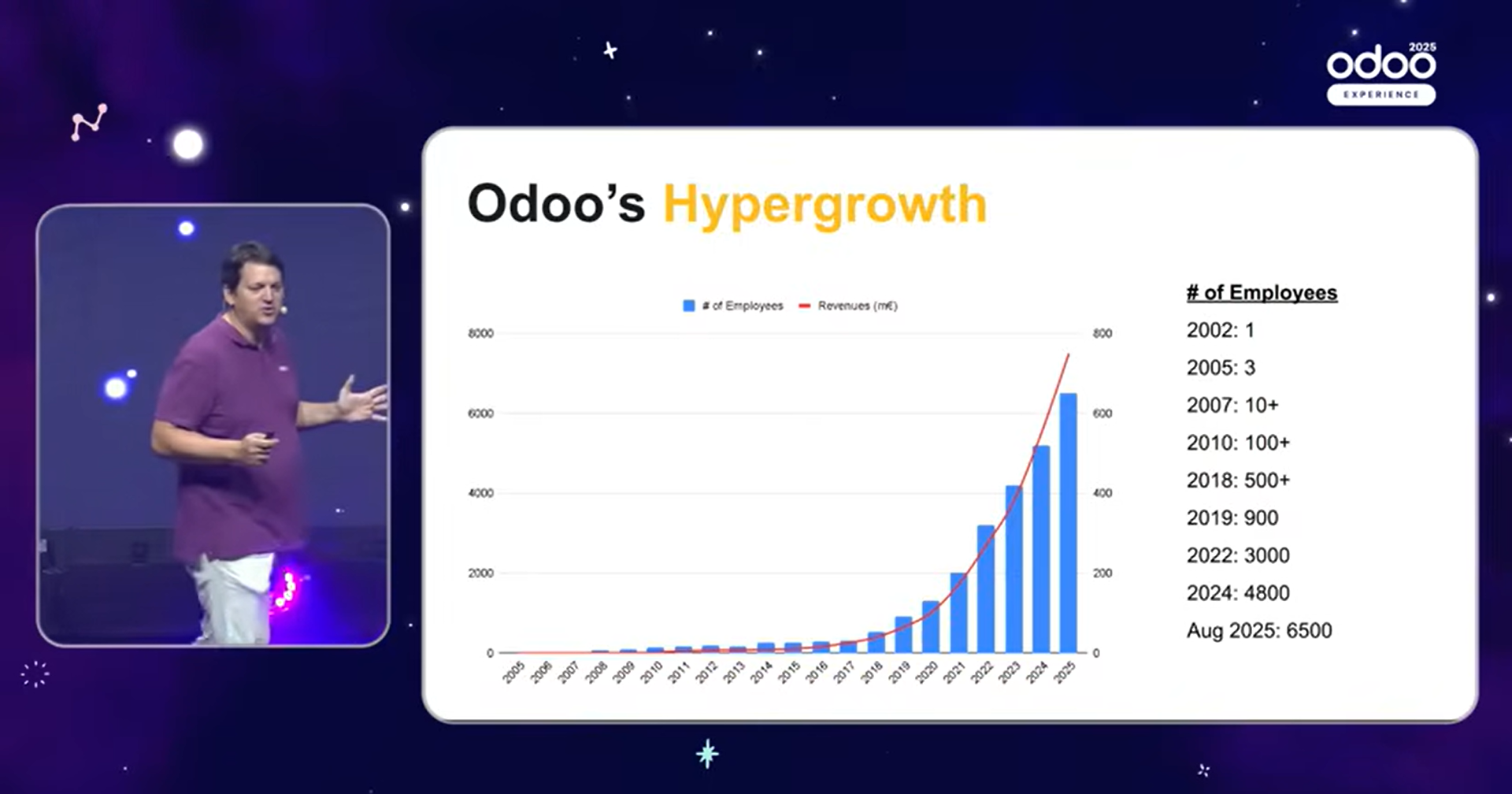
How the headcount has grown
From founding the company alone in 2002, it now has 6,500 employees.
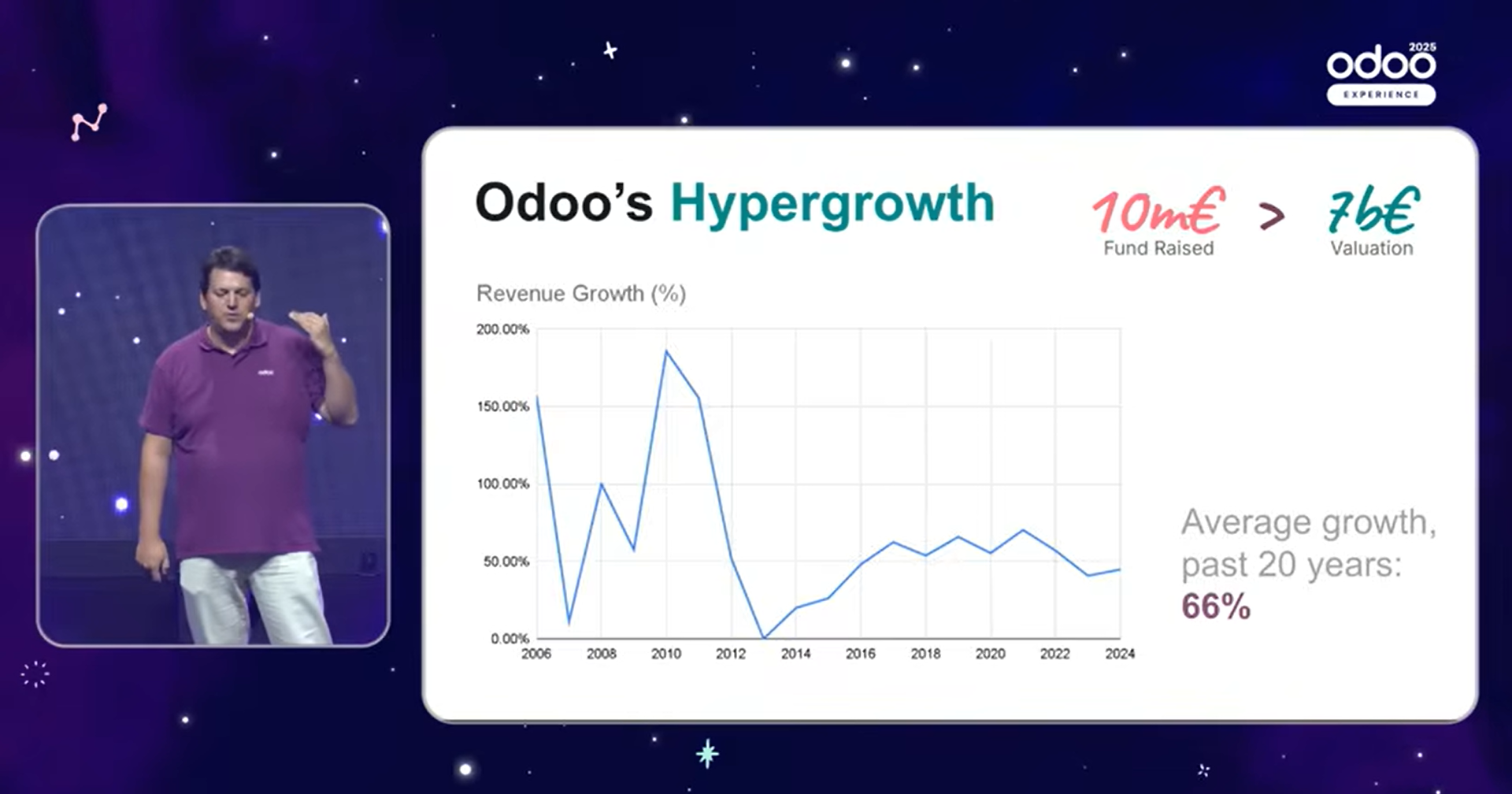
How revenue has grown
Growth has averaged 66% over the past 20 years. Against €10 million raised, the valuation stands at €7 billion.
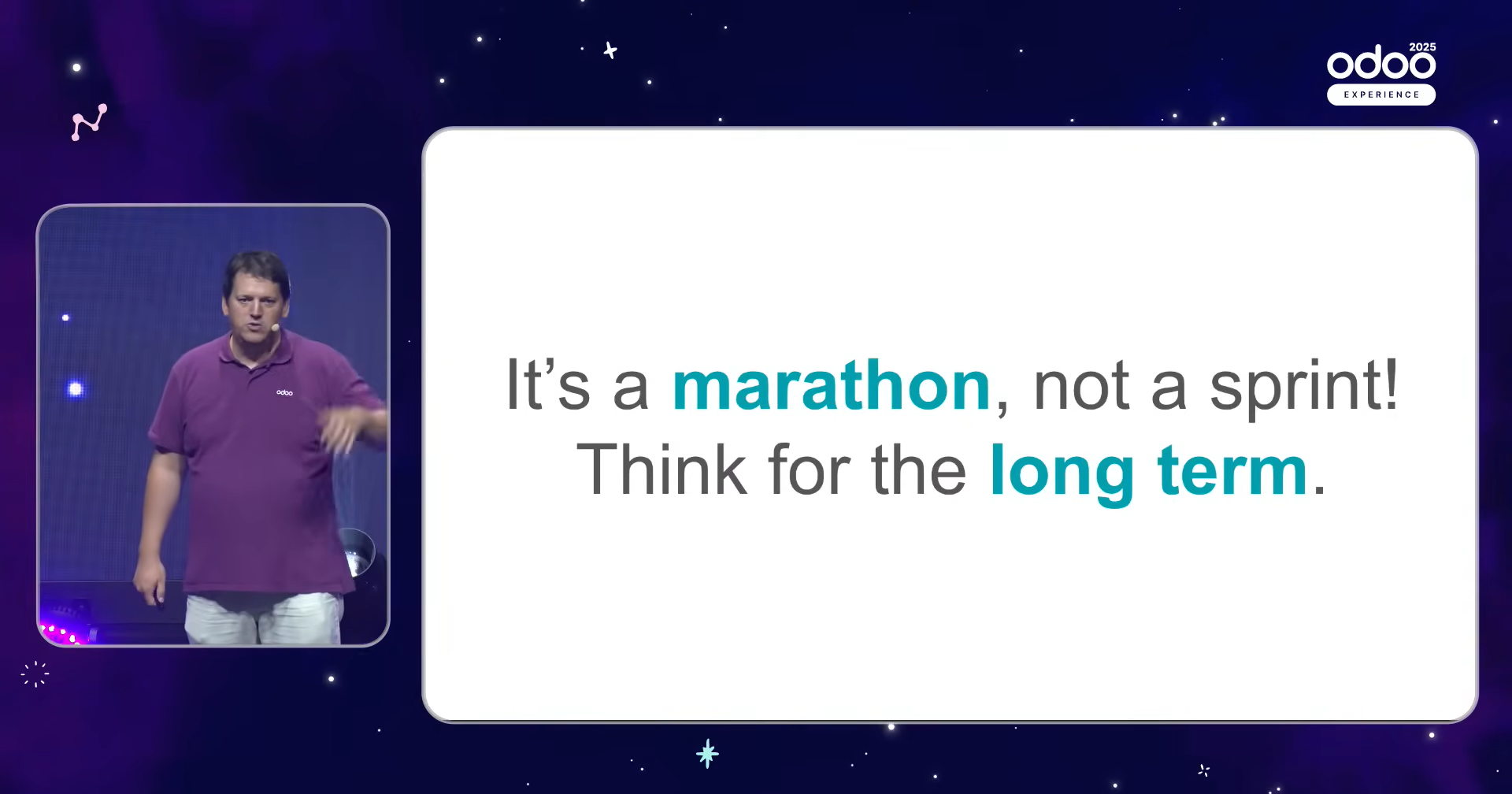
Running a company is a marathon, not a sprint
Run it with long-term thinking. Put the effort into training material that stays useful over the long run, for instance, rather than into newsletters and blog posts whose effect is short-lived.
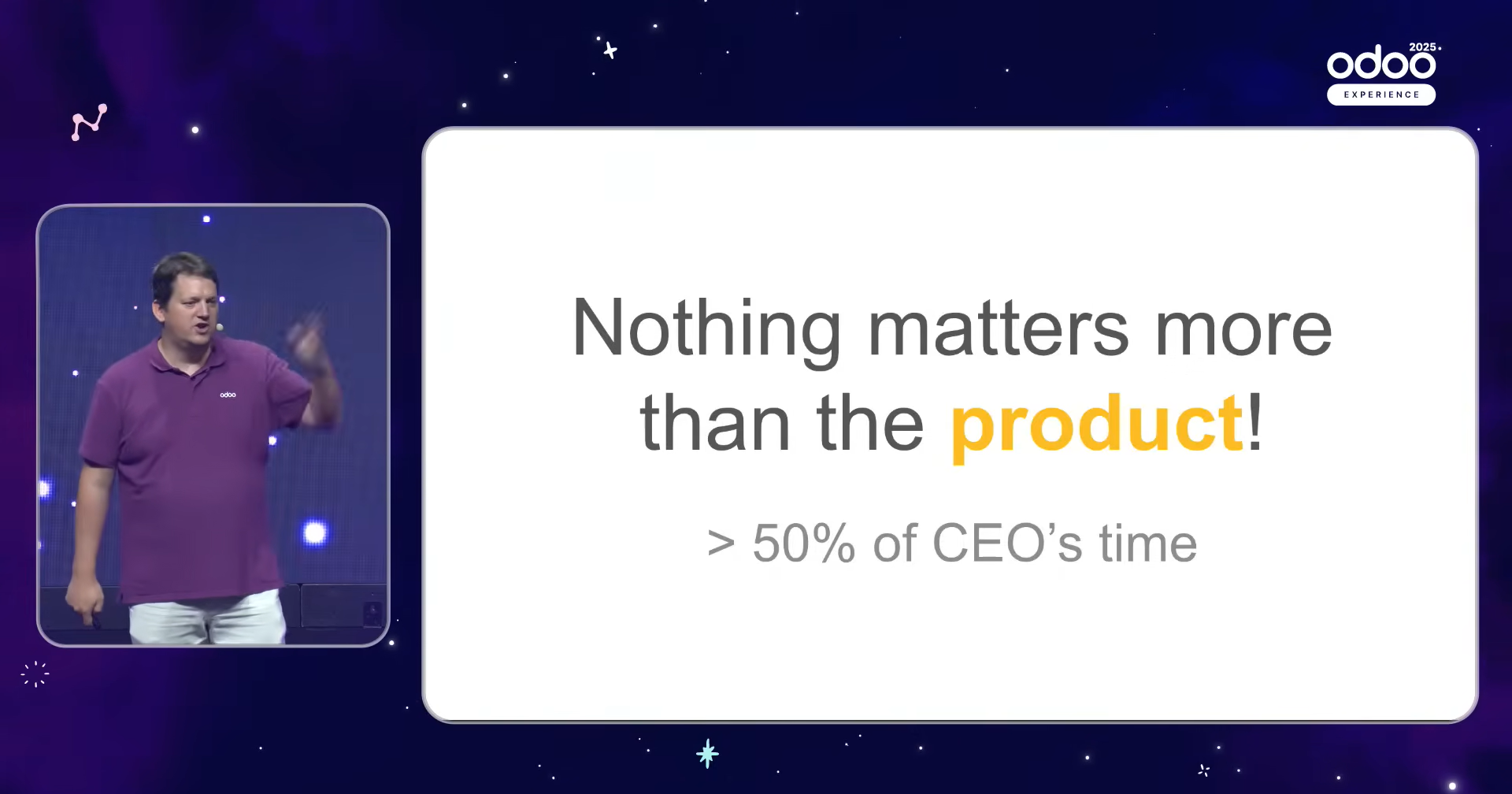
Nothing matters more than the product!
He still spends more than 50% of his working hours on the product. No time is wasted on parties or entertaining.
Pricing matters
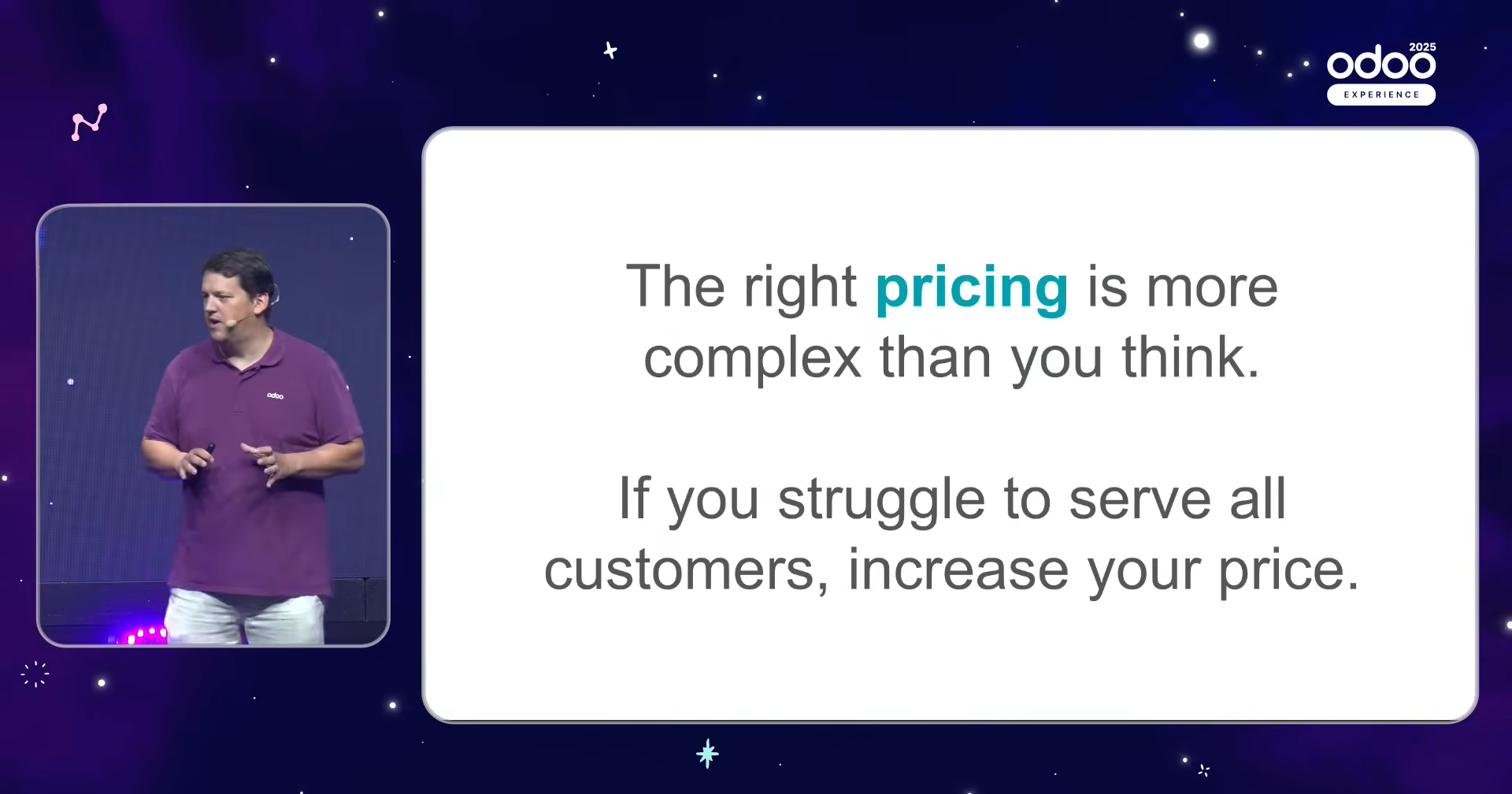
There was a period of changing the prices every year, and it cost the company its customers' trust. That is the biggest mistake so far — and conversely, the change to the pricing three years ago was the biggest success.
Building the business model matters
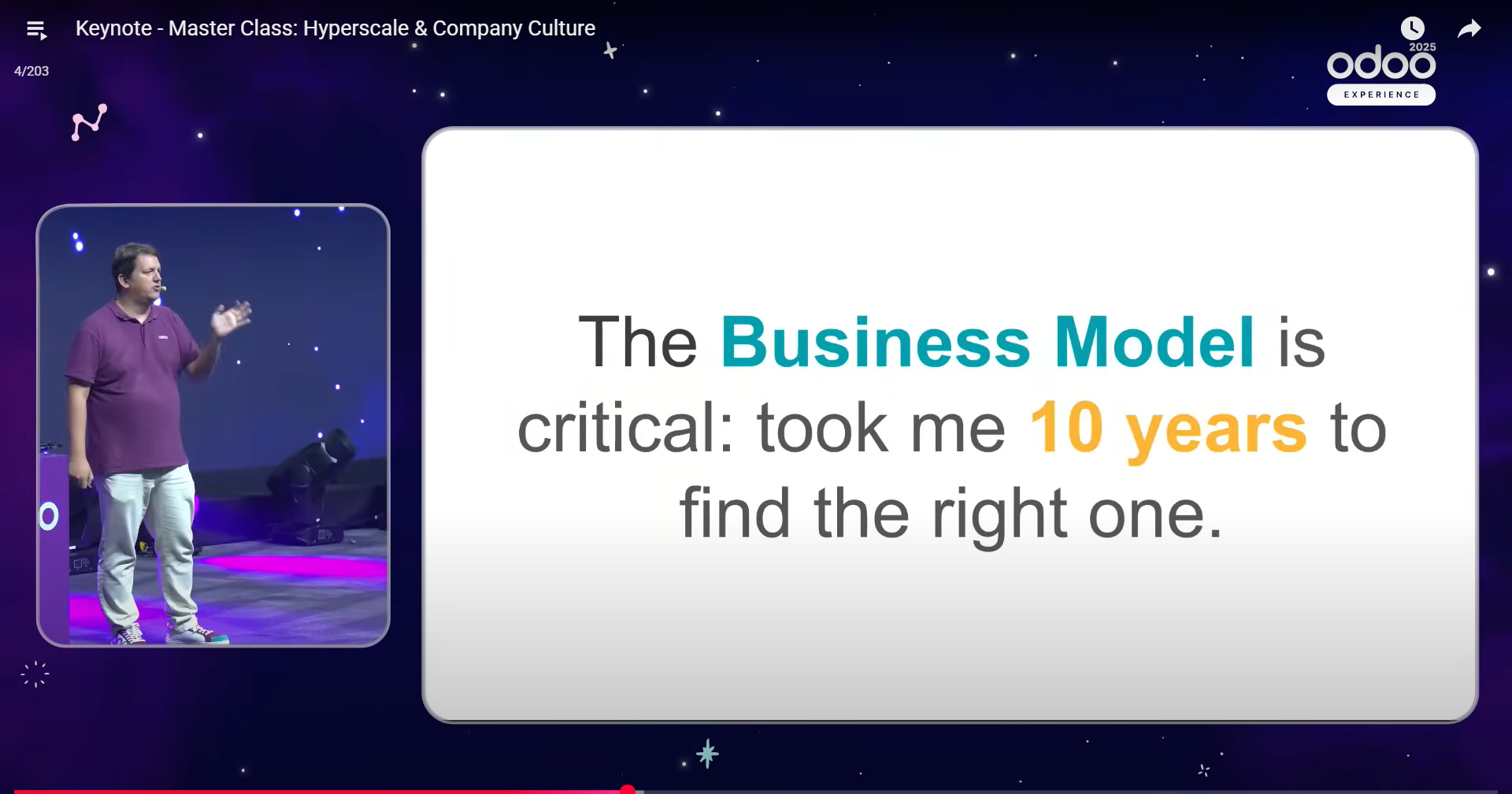
It took 10 years to build the business model. Revenue came from services at first, but customers do not want to pay for maintenance once the system is in. There was a strong attachment to open source, but making all of it open source left no way to fund the development, so the company moved to an open-core model: 80% open source, 20% paid.
Raising money is a means, not an end
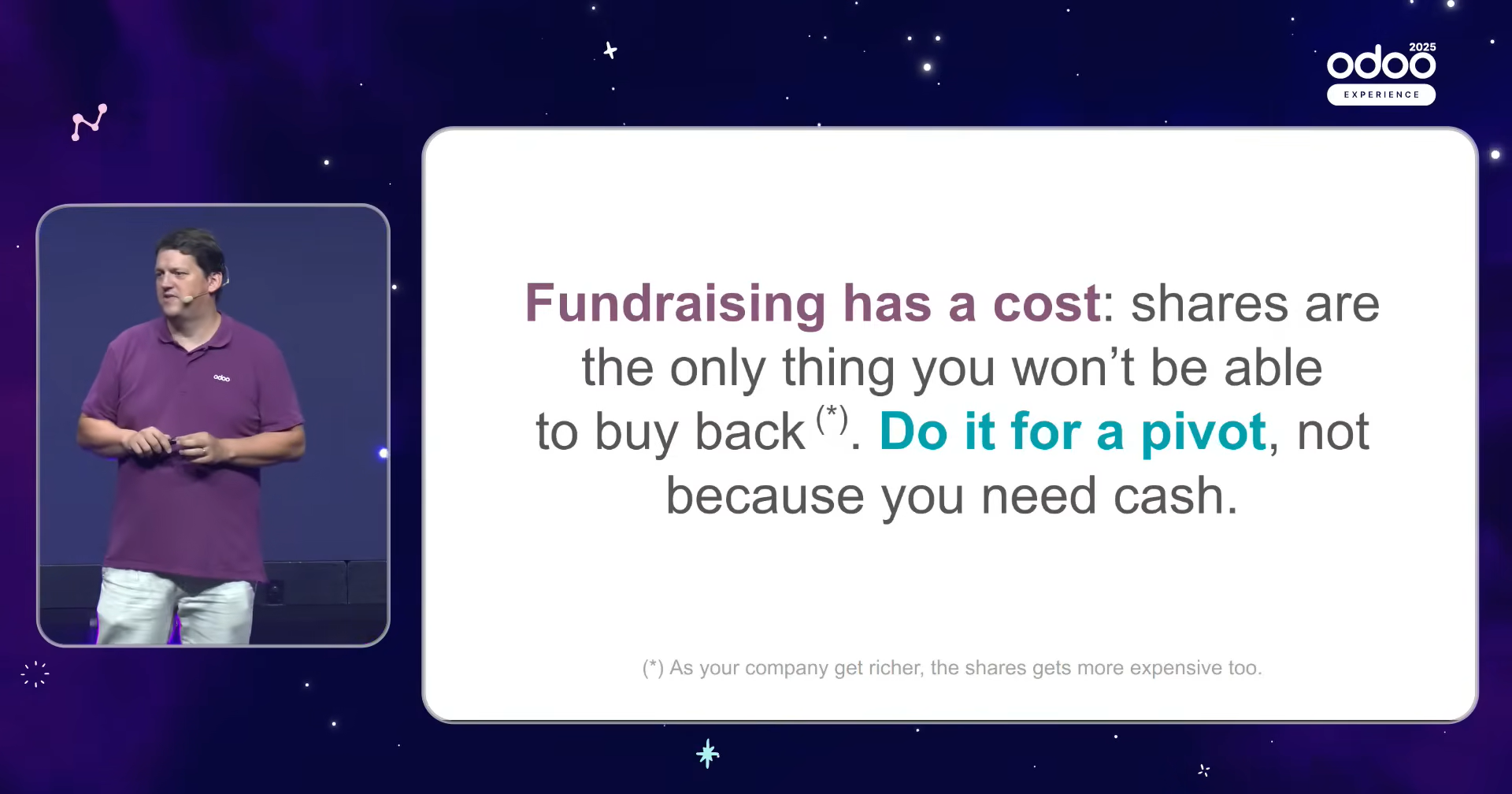
You raise money in order to turn the business around, not in order to have cash. You cannot buy the shares back, so recognise that raising money is a cost.
The hard years
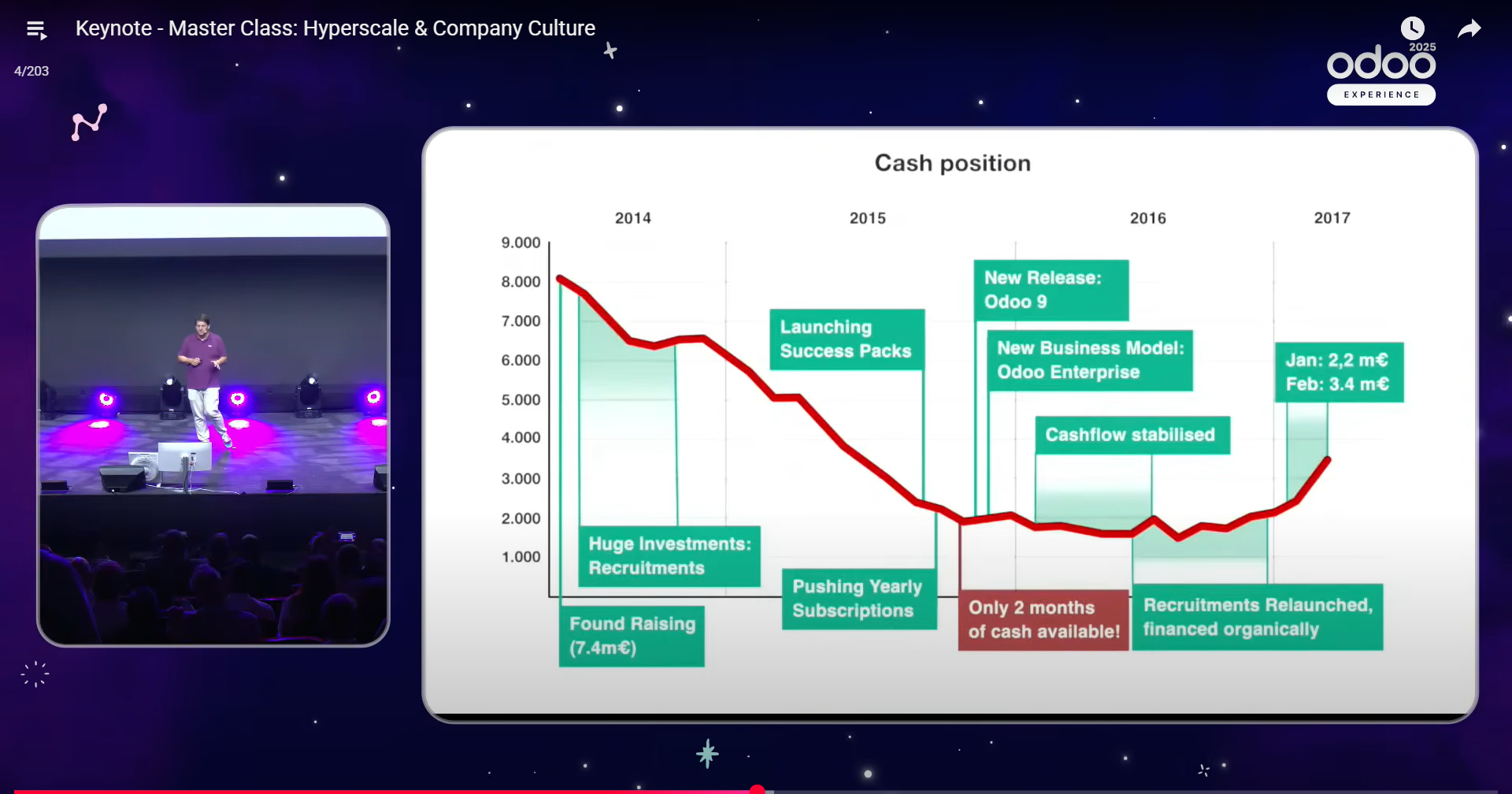
For seven years there were on-and-off brushes with going under — not being able to pay this month's salaries — but after changes such as moving subscriptions from annual to monthly, the cash flow steadied.
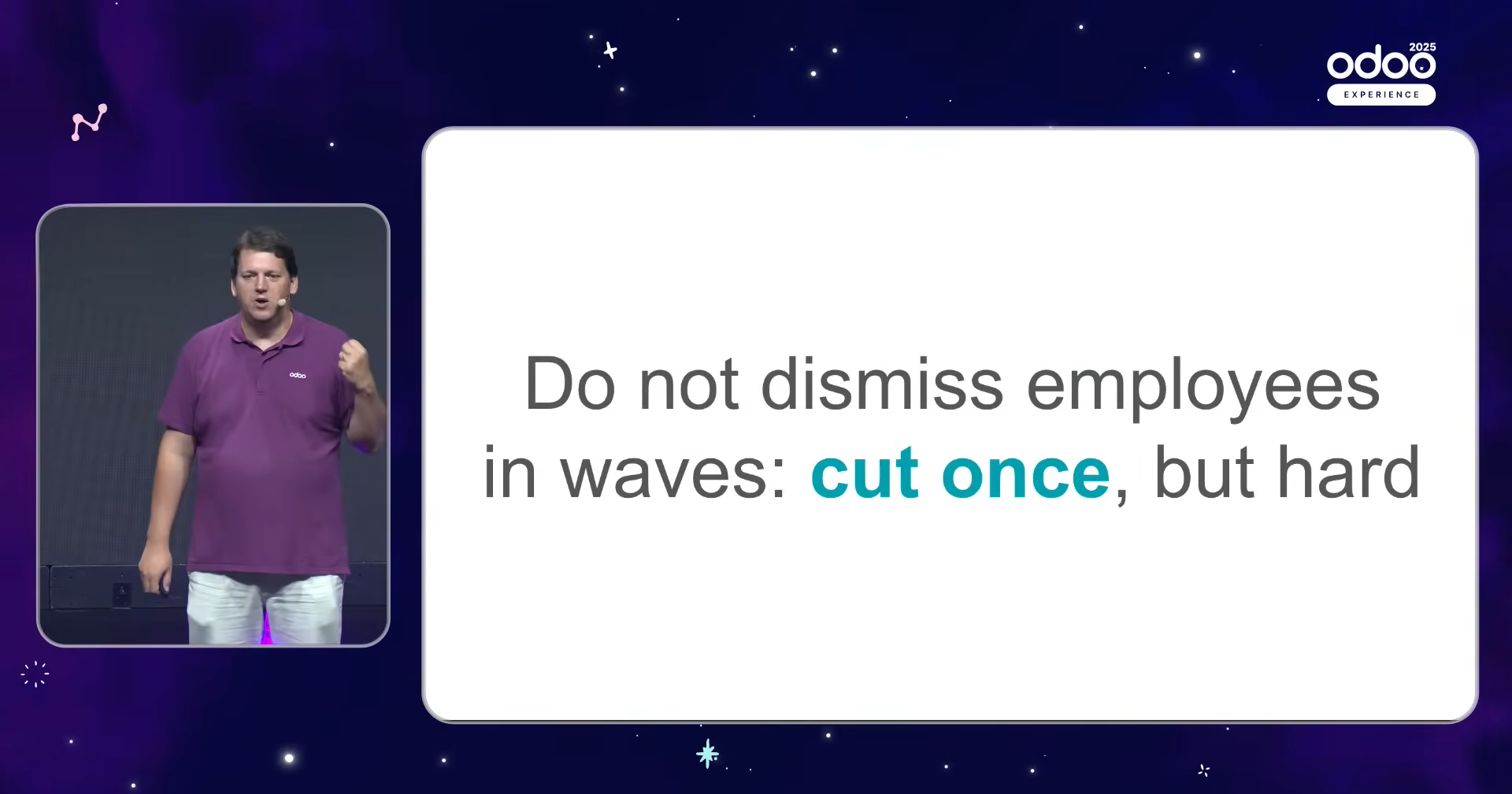
Cutting staff in stages saps the motivation of the people who remain. When you cut, cut in one go. It is precisely when the results are bad that communicating properly with the employees who stay matters.
Execution above all!
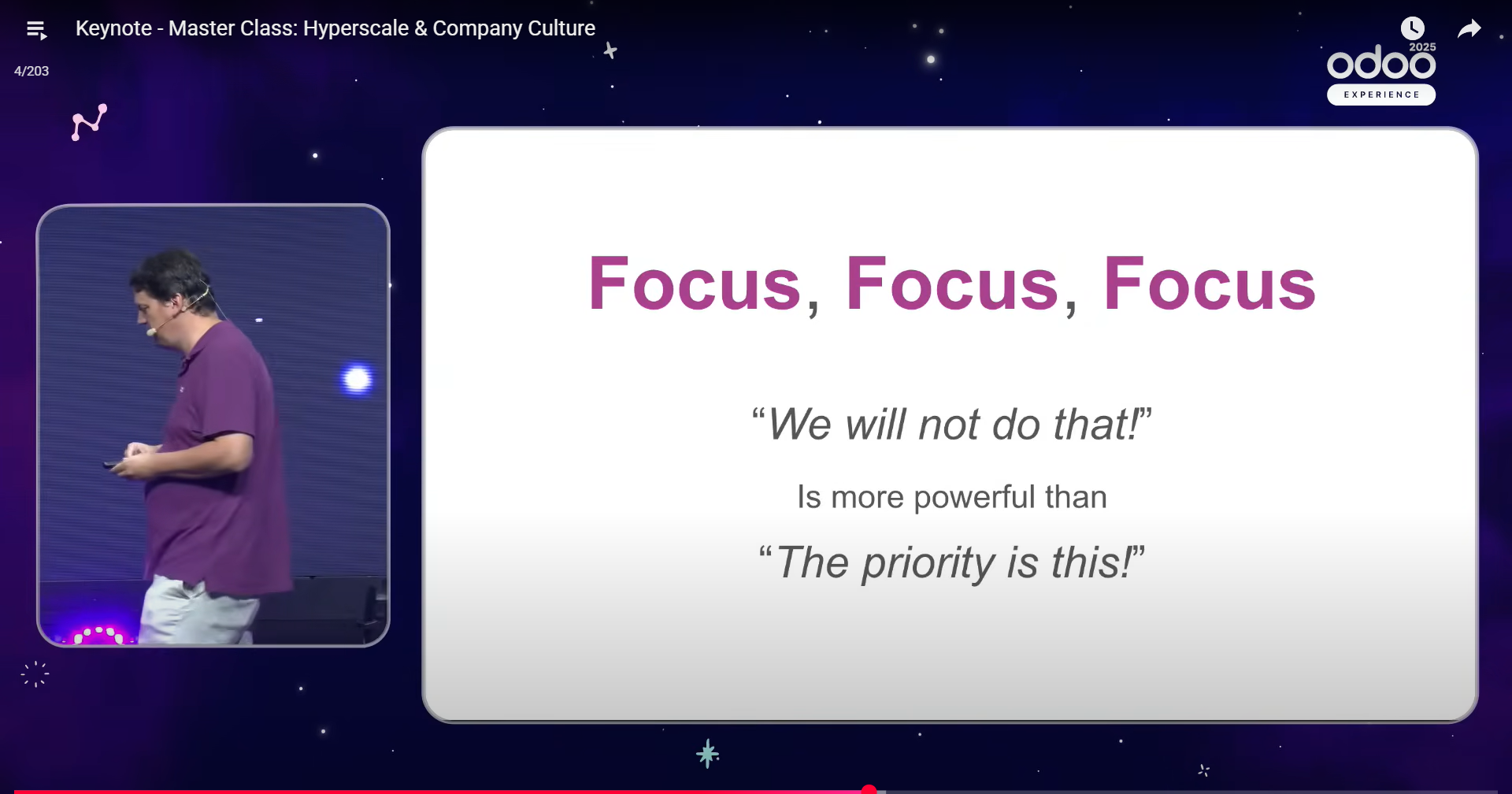
Execution matters more than plans, standing meetings, budgets, control or management by objectives.
Decide what not to do rather than what to do. Focus is what matters.
Ten years ago, when the decision was made to move Odoo to the web, a whole year went on that alone. Developing new features was forbidden; the only focus was the move to the web.
Be simple!
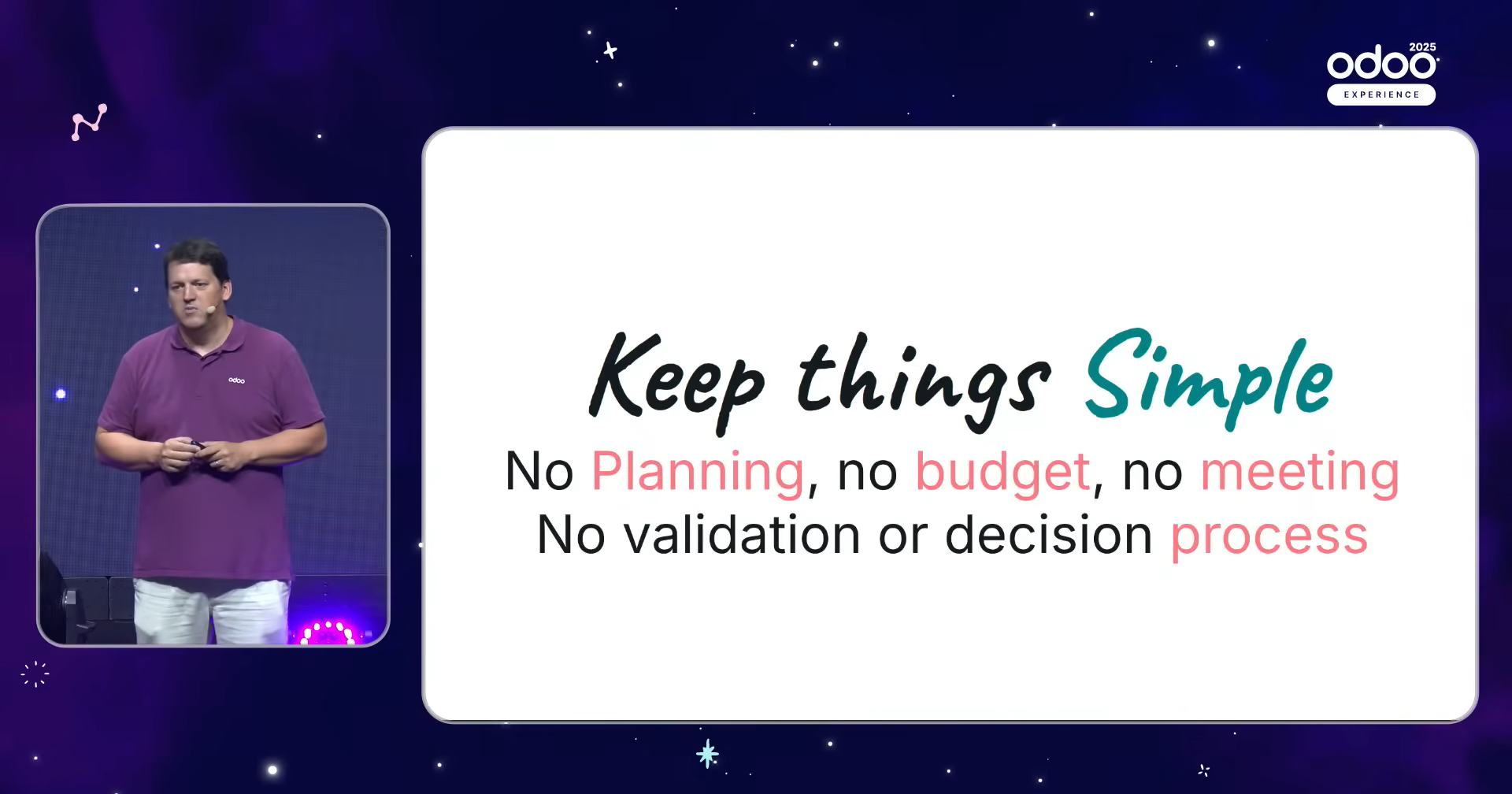
Being simple is something the company values. The contract for Odoo Enterprise, for example, runs to eight pages. Being simple means detailed plans, budgets, standing meetings and approval or decision processes are not needed. Rather than setting a budget, what matters is that people work the numbers out and decide for themselves, and take responsibility for it. Set a budget and all that happens is that the budget gets spent.
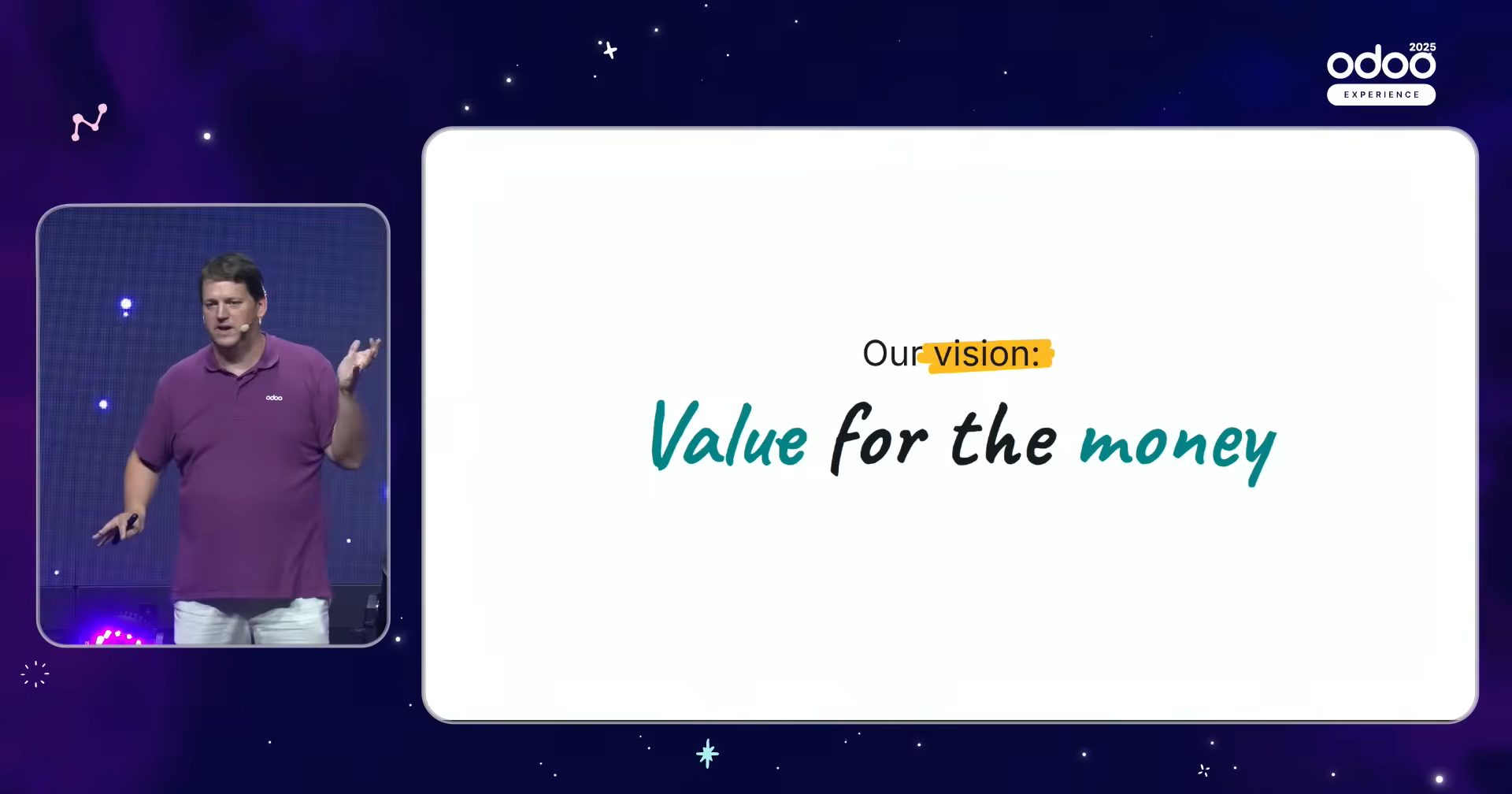
Our vision is to raise the value you get for the price
Raising the value of the product, and lowering the total cost: through those two, the past 20 years have gone into raising the value you get for the price.
Hire on ability, not on knowledge or experience
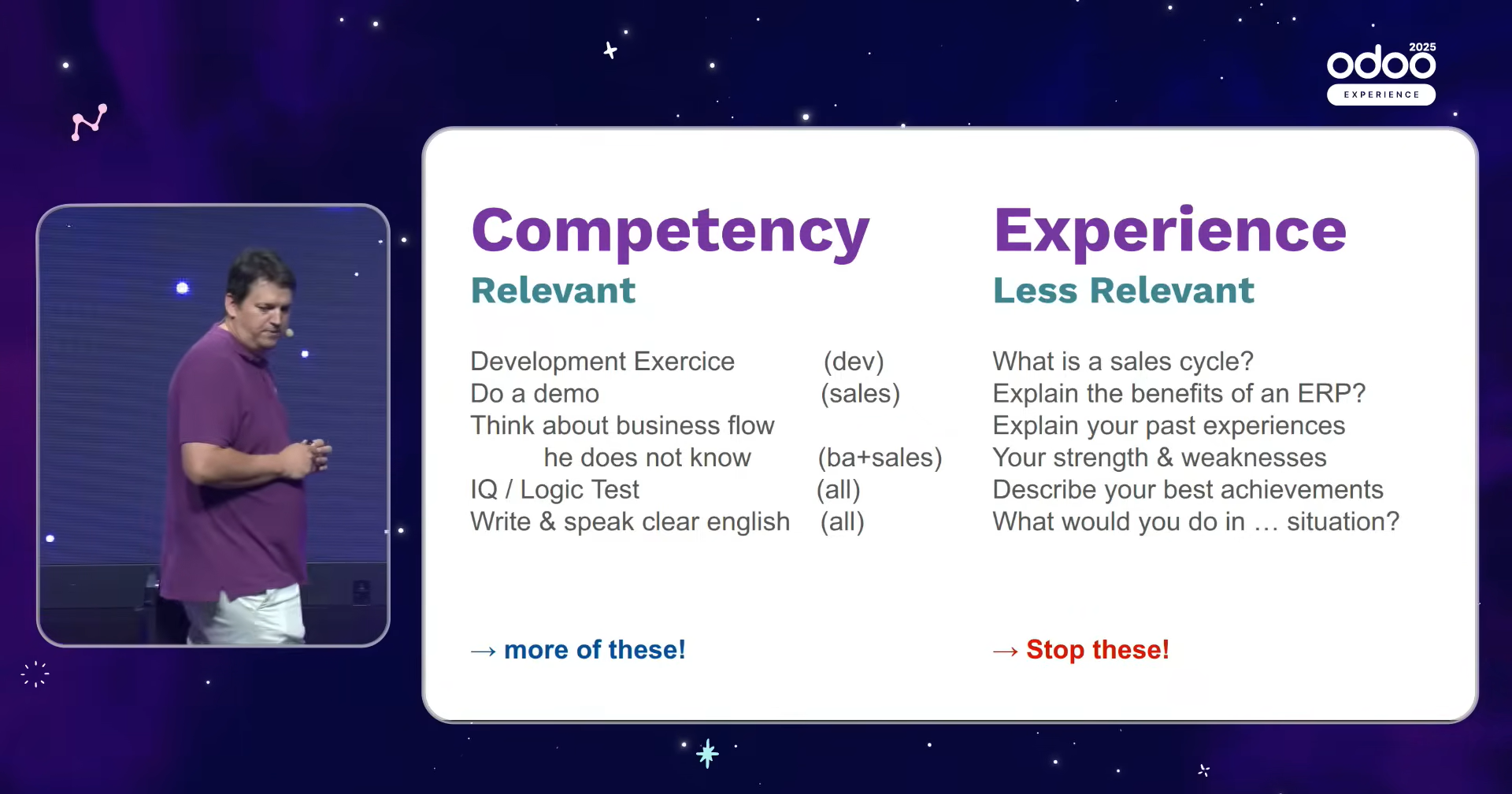
Developers get a development exercise, salespeople a demo, business analysts a business flow in a field they know nothing about — and everyone sits an IQ and logic test and is tested on writing and speaking English.
Where a hire turns out to be a mistake, it is better to let the person go within the year. To keep the culture of the company, an employee who does not fit is let go early.
Be a team leader rather than a manager
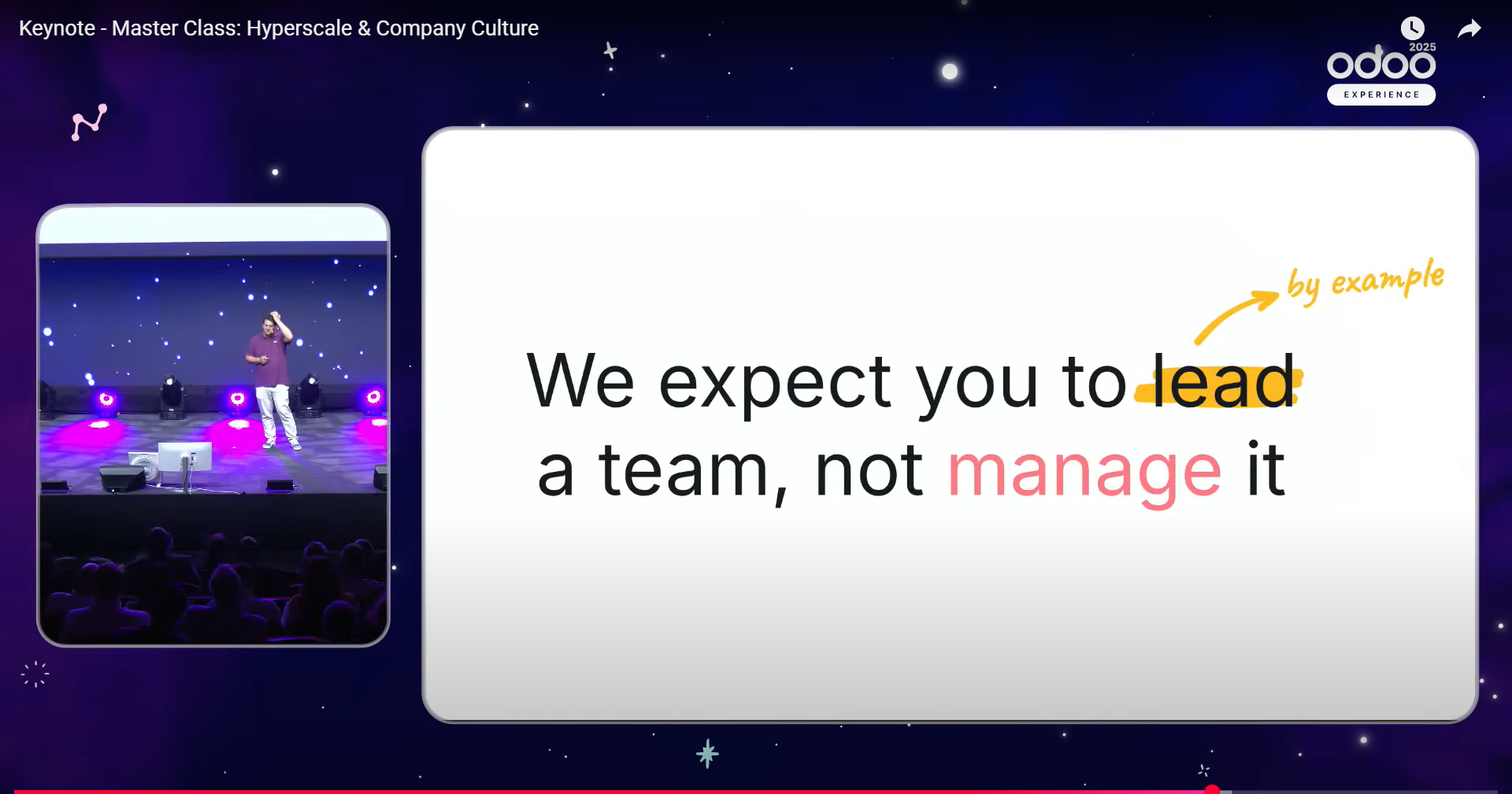
A team leader's job is to pull the team along by example. It is not to manage it.
What a team leader is for
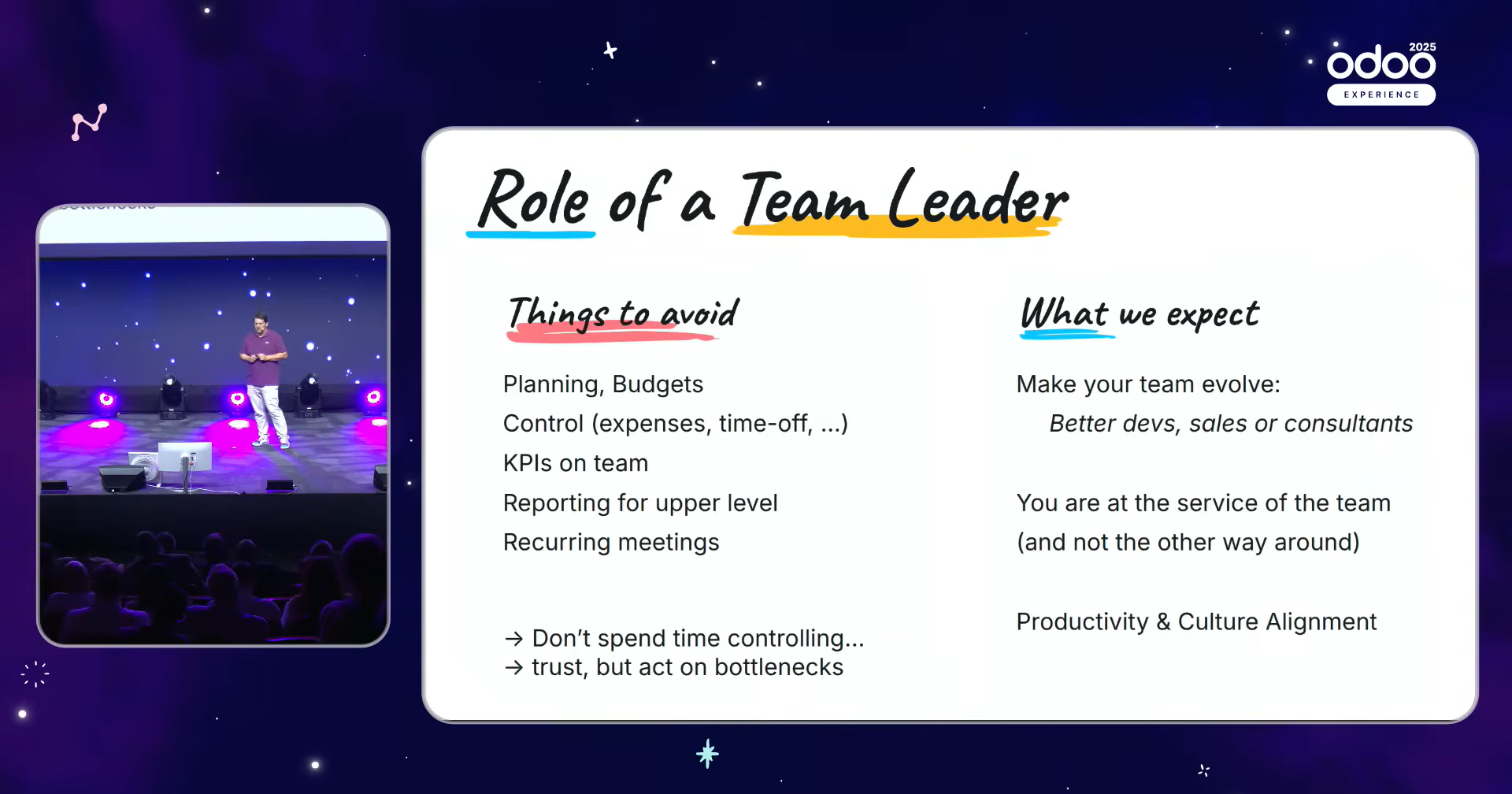
A team leader is not there for planning, budget control, expenses and leave, KPIs or reports. The job is only to make the team better: setting things up so the members can learn from the leader, trusting them, helping where there is a bottleneck, and letting them get more productive.
Micro-review, not micromanagement
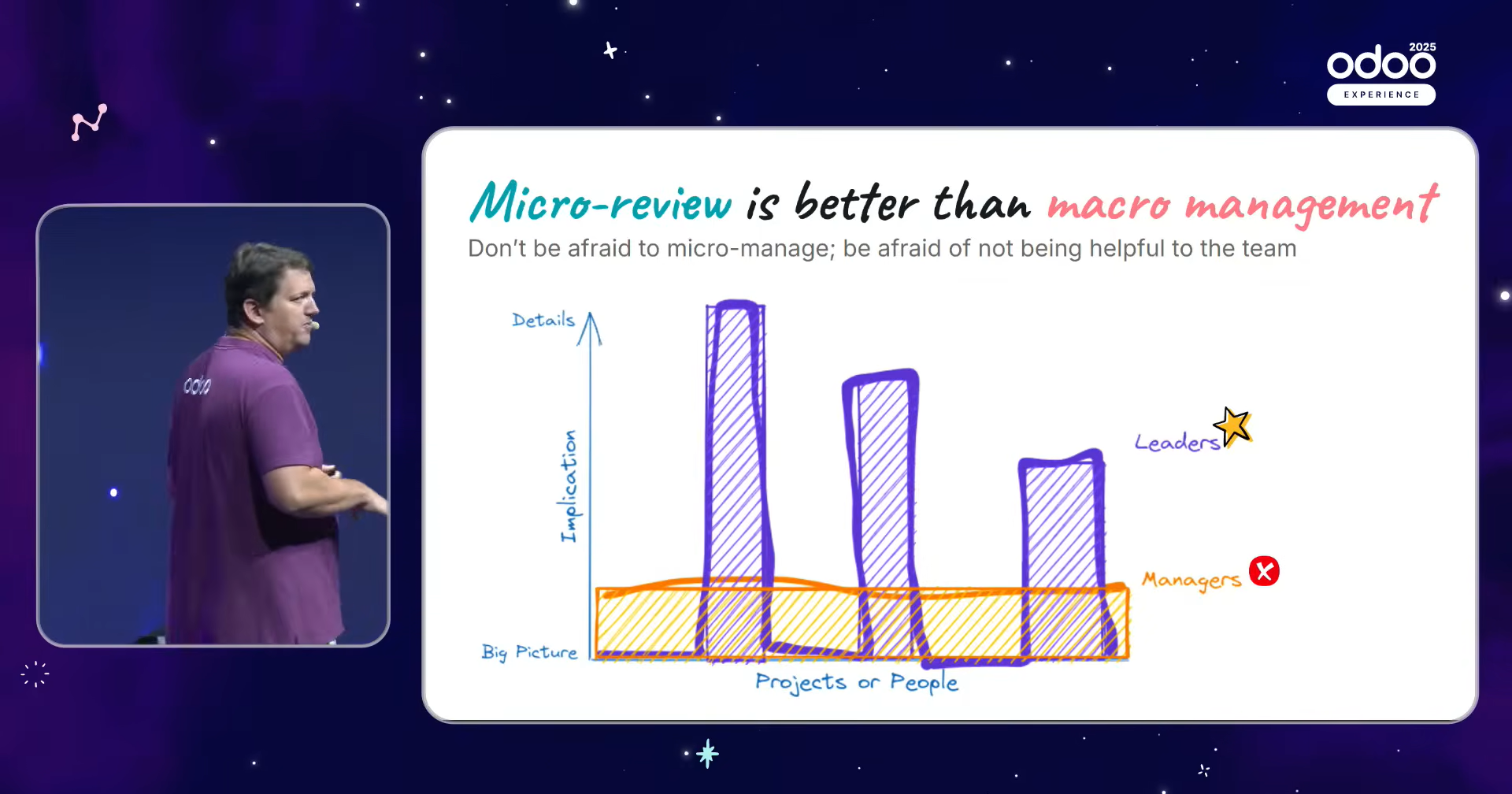
A manager spends their time evenly across everything. A team leader concentrates their time where an important issue has come up.
How to choose a team leader
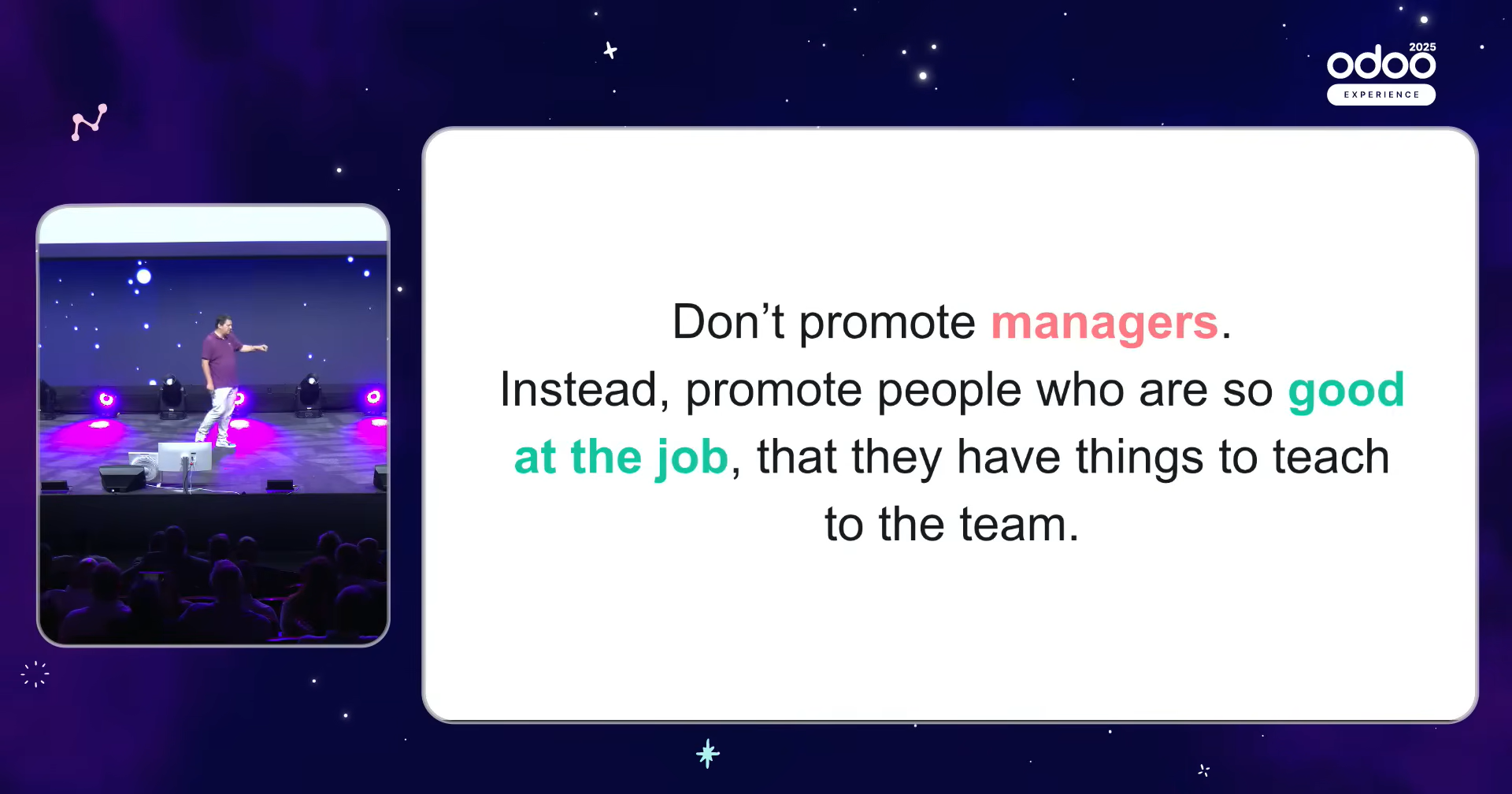
Promote the person who is good at the job rather than promoting a manager — because they can teach the team.
Motivation
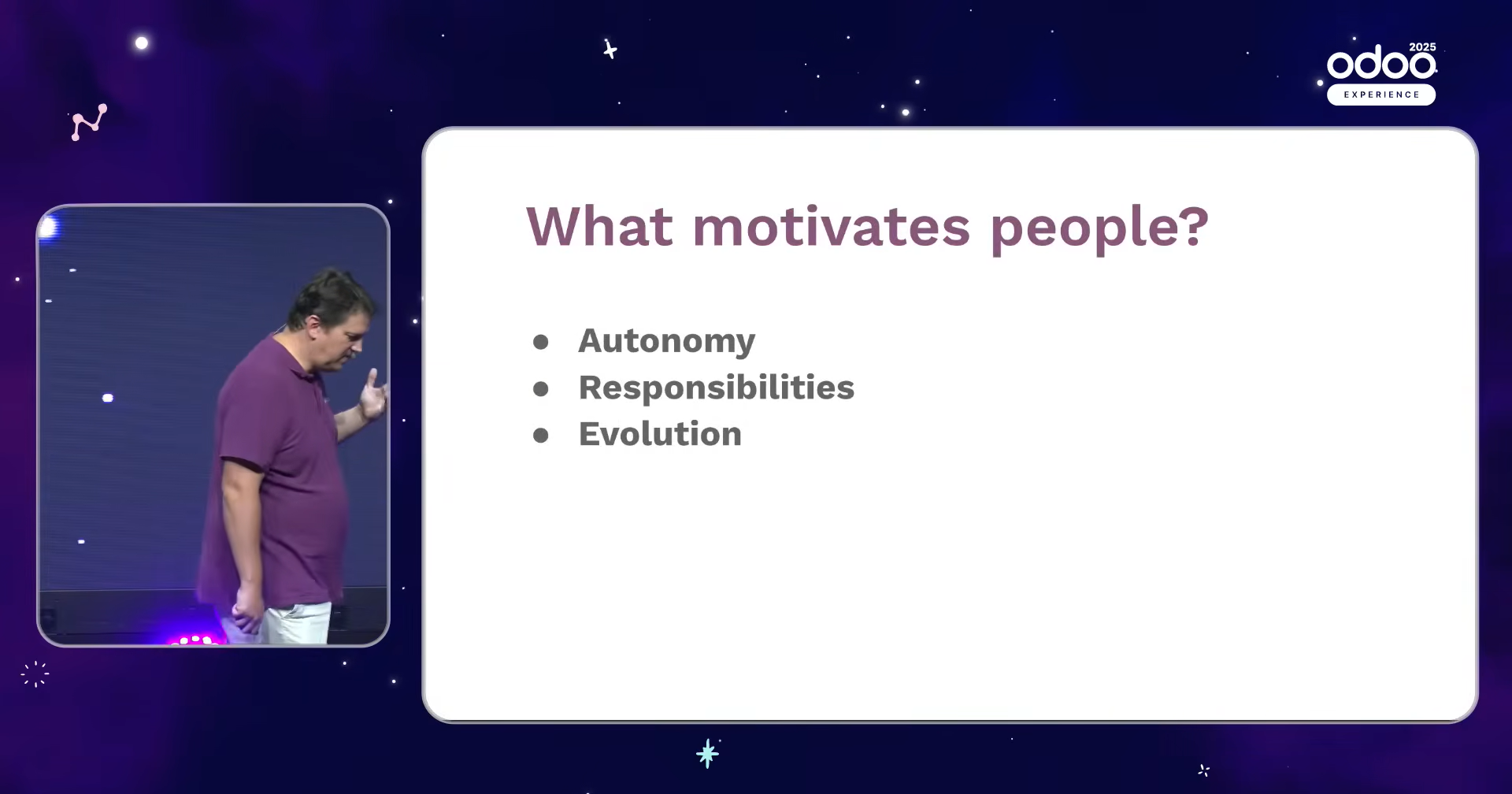
Motivation comes from autonomy, from responsibility, and from evolving and growing.
If you want to grow as fast as we have, use Odoo!
Related links:
Odoo Experience 2025 Keynote - hyperscale growth and company culture