
This is about the opening line of an email. For a long time now we have, as a rule, avoided opening ours with 「いつもお世話になっております」 — the stock Japanese business greeting, roughly "thank you for your continued support".
When Tim, one of our consultants (from Hong Kong, and a Japanese speaker), had newly joined, I saw them drafting a customer email that opened with 「いつもお世話になっております」, and said it would be better to deliberately drop it.
It is a small thing, but for anyone wondering why — there may not be many of you — here are my own reasons.
1. 「いつもお世話になっております」 creates no value
Our founding purpose is "to provide more flexible, more cost-effective business management system services". Pursuing the cost-effectiveness in that purpose means stripping out, as far as we can, anything in the work that creates no value — not only the parts that touch the system directly. Otherwise the sign over the door is a lie.
In practice I think the phrase has become largely an empty form. Even someone emailing us for the very first time will often open with it. My honest reaction is: but we have never even met… I don't say so, of course.
Customers we do deal with regularly often open that way too. If they find value in our service and this is how that shows itself, then that is something to be grateful for.
Turn it around, though: is there value in us writing it when we contact a customer? "Isn't it rude not to?" — that view exists, naturally. But what a customer wants is not that courtesy so much as their business or system problems solved. Solving one single thing that is troubling them is worth more than saying 「いつもお世話になっております」 ten thousand times.
2. Writing 「いつもお世話になっております」 costs a little
Say it takes 10 seconds to type. At 10 emails a day, and 180 working days in a year, that is 18,000 seconds a year, or five hours. At a cost of 3,000 yen an hour, 15,000 yen. Across ten people, 150,000 yen a year. For 150,000 yen you could get several small Odoo customisations done.
Perhaps that is not a large sum. But if 150,000 yen unexpectedly landed in my pocket, I would do a little dance somewhere nobody could see me.
3. Writing 「いつもお世話になっております」 dilutes the message a little
When you write an email for work there is always some purpose to it. The phrase almost certainly carries no information that serves that purpose. Which is to say that putting it in does nothing but dilute — only slightly, but still — the message you actually meant to convey.
With text-based exchanges like email it is hard enough in the first place to get a message across at full density. So information unrelated to what you want to say should be kept out as far as possible.
4. 「いつもお世話になっております」 closes you into Japan
I don't know every language and culture, so this is a comparison with English and Chinese — but the expression is quite particular to Japan. In business email in English or Chinese I don't think you would say anything of the kind.
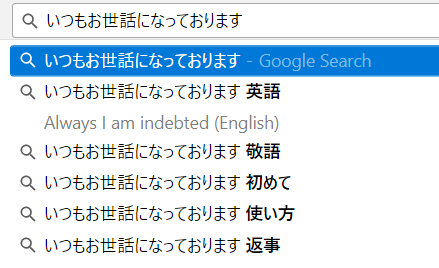
Type 「いつもお世話になっております」 into Google's search box and it suggests 「いつもお世話になっております 英語」 — the phrase plus "English". Plenty of people must be looking it up.
Every country and region has its peculiarities, and those of us who build businesses have to get along with the peculiarities of our market — but fundamentally, peculiarity builds walls. It makes it harder for companies abroad to approach the Japanese market, and, at the same time, harder for Japanese companies to approach markets abroad. Leaving walls like these standing in a market that is going to shrink from here produces Galapagos conditions in all sorts of places. As a tourist attraction that may even be part of the charm, but in most industries what Galapagos isolation brings is a slow bleed.
So I think customs that only carry within Japan are better dropped, in business especially, wherever there is no reason to keep them.
5. Keeping 「いつもお世話になっております」 up means missing all sorts of irrationality
Ask whether the phrase is rational and, for the reasons above, it probably is not. But as things stand I think most people write it because that is simply how it is done, or because saying it is the safer bet.
Changing a custom you have kept up until now carries a certain psychological resistance, but dropping this one is something anyone can act on immediately if they choose to. Of all the changes you could bring about by your own will, this must be among the easier ones.
Setting aside anyone who does find some rationality in it: if you keep it up out of inertia and leave that unexamined, then even when you do notice some irrational custom or situation, won't you find yourself unable to act on your own will to change it?
In summary
So if our email ever strikes you as unadorned, or too blunt, we would be glad if you read it as deliberate, for the reasons above.
To make the point clearly I have rather dwelt on the phrase's "irrational" side, but my view is only one view, and in truth the customers who do write it are, every one of them, people I hold in high regard. Take it as one more way of looking at things, laugh it off, and have a good new year. And we will hold the sentiment behind 「いつもお世話になっております」 while leaving it out of our email, and keep working — clumsily, and bit by bit — to grow the value we can offer.
Photo by Volodymyr Hryshchenko on Unsplash
We have decided not to write the customary Japanese email opener