![[Odoo case study] SFA Japan: instant head-office reporting, and mid-month cut-off consolidated invoices](/web/image/blog.post/122/author_avatar/%5BOdoo%20case%20study%5D%20SFA%20Japan:%20instant%20head-office%20reporting%2C%20and%20mid-month%20cut-off%20consolidated%20invoices?unique=1e1130d)
It has been a while since our last case study (implementations keep coming, but there are several we have been too busy to write up). This one is the Odoo implementation at SFA Japan K.K. Within the wider frame of a French global company rolling Odoo out to its sites worldwide, Quartile supported the implementation at the Japanese subsidiary.
The short version:
- Sales and stock data shared between head office and Japan in real time
- About ten hours a month saved on routine reporting, and 100% of after-sales work entered into the core system
- A consolidated invoice feature meeting mid-month cut-off and qualified invoice requirements added to OCA under AGPL
About SFA Japan
The SFA group is a sanitary equipment manufacturer founded in France in 1958, a pioneer of macerating pumps operating in more than 70 countries. SFA Japan, its Japanese subsidiary, imports and sells the group's products. It supplies remarkable products that let toilets, kitchens and other water-using fixtures be installed or added flexibly without major construction work, with a wide track record in Japan from homes through to commercial premises.
SFA Japan website: https://sfa-japan.jp/
Project overview and background
- Scope: Sales, Purchase, Inventory, Invoicing
- Version: 16.0 CE
- Users: around 10
- Project period: 9 months
- Effort: around 600 hours
The SFA group has adopted Odoo as the platform for closer information sharing with its subsidiaries around the world, and is rolling it out to each of them in partnership with local Odoo service providers.
SFA Japan had been running Yayoi Sales as its core system, and information sharing with the French head office depended on monthly aggregation done outside the system, which made timeliness a problem.
For the Odoo implementation at SFA Japan, Quartile's services were chosen because of our record of activity in the Odoo Community Association (OCA), and because we can communicate with the French head office in English.
The SFA group's Odoo roll-out overall is supported by Komit, an Odoo partner in Vietnam, and we needed to work with them too, to set up the infrastructure and to understand how the group-wide features fit together.
Running the project
Through the project we held weekly meetings with SFA Japan and weekly meetings including the French head office, repeatedly reporting progress, taking stock of open questions, setting actions and building the schedule, and brought the system towards its finished shape that way.
Early on, the weight fell on coordinating with the head office and Komit. From the middle, once Quartile understood the group-wide givens, we worked on the requirements specific to Japan. Towards the end we concentrated on the operational design around accounting, and on reaching a shared understanding with the accounting firm, ready for the switch to Odoo.
All the project work was done remotely, though we did meet Ogino-san, SFA Japan's representative, on a business trip to Fukuoka, and met the head office IT team in Belgium at Odoo Experience 2024.
A Japan-specific requirement: mid-month cut-off consolidated invoices
One large theme we recognised early was the monthly consolidated invoice. In Japan, industries with frequent transactions against particular customers — manufacturing, wholesale, retail — customarily issue a consolidated invoice, and SFA Japan does this too.
Odoo alone does not meet that requirement adequately. The standard functionality can invoice several orders together, but once a mid-month cut-off of the kind common in Japan is involved — the 20th, say — consistency with the accounting period breaks down.
We had been aware of the gap for some time. On previous Odoo projects we had managed either because the terms of trade happened not to involve a mid-month cut-off, so the standard functionality would do, or by moving the customer to individual invoices. At SFA Japan, though, the process built up with their trading partners could not be disturbed, so it had to be handled in the system.
That was the largest gap on this project, and it led us to build a consolidated invoice feature that satisfies the accounting requirements.
Beyond it there was no large structural gap between the requirements and how Odoo works. For requirements where we judged the system should be adjusted, we did as we always do: use an existing OCA module wherever possible, and where OCA has nothing, build it and propose it to OCA.
Reaching agreement on a global Odoo roll-out
For its size, the project had a relatively large number of stakeholders, which made it a little different from a typical Japanese Odoo implementation on the same scale. Besides the user, SFA Japan, we had to work with the head office IT and finance departments, Komit and the accounting firm, joining up the information and arriving at the right conclusions.
Rolling a core system out globally means a framework — group-wide policy and so on — is already settled to some degree, and you have to understand it and fit your approach to it. You also have to work out how information currently flows between the organisations involved, show how introducing Odoo changes that, or should change it, and then make the change real. The difficulty sat more in project management and change management than in implementing functionality, and keeping the goal in sight while aligning stakeholders across languages took some care.
On working with Komit, the platform and the procedures they use were not the ones we are used to, and at first that was disorienting. But Komit are OCA contributors too, so we started from a shared understanding of the thinking and of OCA's solutions, and the collaboration went remarkably smoothly.
What the SFA group gained
With Odoo in place, sales figures and stock levels are shared between the French head office and SFA Japan in real time, and the information flows between them are much denser.
Previously, sharing sales figures inside SFA Japan and sharing profit-and-loss analysis with head office each meant building reports out of Yayoi Sales data with a good deal of macro work. That is now done by Odoo's own reporting, saving about ten hours a month.
We were also able to bring the after-sales department's work into Odoo. After-sales requests arrive unpredictably from all sorts of clients, so managing that information in a system had been left behind. Adopting Odoo became the occasion to move to entering 100% of customer orders into the core system promptly.
The overriding goal of the Odoo implementation at SFA Japan was to unify the group's operational foundation; frankly, not much was expected of it in terms of improving the efficiency of Japanese operations. But by helping the users understand how Odoo works, and by using OCA modules and others to build in the business logic they needed, automate things and improve how it handles, we produced a certain amount in data entry and reporting as well.
What the community gained
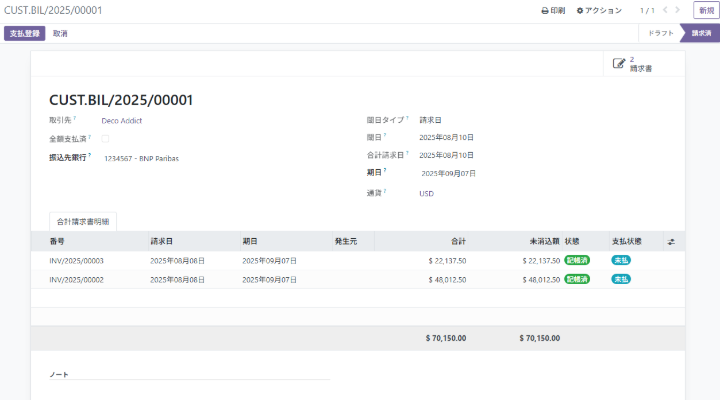
The consolidated invoice feature developed for use at SFA Japan has been published under OCA as an open source module (AGPL licence) that anyone can use.
By separating revenue recognition in the accounts from the consolidated invoice, the feature secures revenue and cost recognition at the right time while supporting mid-month cut-offs such as the 20th. Recalculating consumption tax at the level of the consolidated invoice also satisfies the qualified invoice requirements.
Japan's consolidated invoice has been recognised by Odoo as a localisation need, but building a solution calls for an accurate grasp of both Japanese business custom and Odoo's design, which has made it a difficult topic for Odoo to take on.
The feature we built depends on existing OCA modules such as account_billing, and there are several other OCA modules it is worth using when setting up consolidated invoicing. Already having those tools to hand, through day-to-day OCA work, is what underpinned the solution.
That the consolidated invoice feature could be added to OCA is owed entirely to SFA Japan's understanding and their willingness to fund it. If you are going to use it, do please consider buying an SFA macerating pump!
In summary
The Odoo implementation at SFA Japan was a project full of the difficulty, and the interest, peculiar to rolling a core system sideways across a global company.
For the SFA group it made information sharing between head office and Japan much faster; for SFA Japan it raised the standard of the operational foundation and tidied up and streamlined the work.
Japanese Odoo users, meanwhile, have gained a consolidated invoice feature as a community asset, and one large hurdle to using Odoo in Japan is gone.
Quartile will go on delivering value to customers in step with community work, contributing to the upkeep and growth of the Odoo ecosystem — and working towards a market where many companies can get high-quality ERP services at a reasonable price.
In the customer's words
Our first priority in adopting Odoo was to keep the burden on our busy staff, on their time and their nerves, as small as possible. In that sense we could not have found a better partner. We were helped in the professional technical areas, and at the same time given a careful understanding of how we work and how the organisation fits together, the French head office included — for which we are very grateful. SFA Japan General Manager • Ogino-san
Through a long project you stayed positive and thorough throughout, and we are grateful for it. When we ran into problems, the proposals took our existing operations into account. Being able to manage after-sales invoicing in Odoo rather than in the old spreadsheets, which has made reconciliation far more efficient, is a particularly large improvement. The careful training and support also let us migrate with confidence. SFA Japan Office Director • Tanigami-san
[Odoo case study] SFA Japan: instant head-office reporting, and mid-month cut-off consolidated invoices