
Our post on the Odoo Experience 2022 Keynote - Vision & Strategy mentioned it as well, but the revision of Odoo's pricing plans was announced at Odoo Experience 2022. Following Odoo S.A.'s own blog post, "Odoo's new pricing", I would like to go through the new Odoo pricing plans, and the background to the revision and what it is for.
The new pricing plans
The new Odoo pricing plans (Japan) announced at Odoo Experience 2022 are here. Charging per app is gone and charging is by user only, which makes it simple and easy to follow.
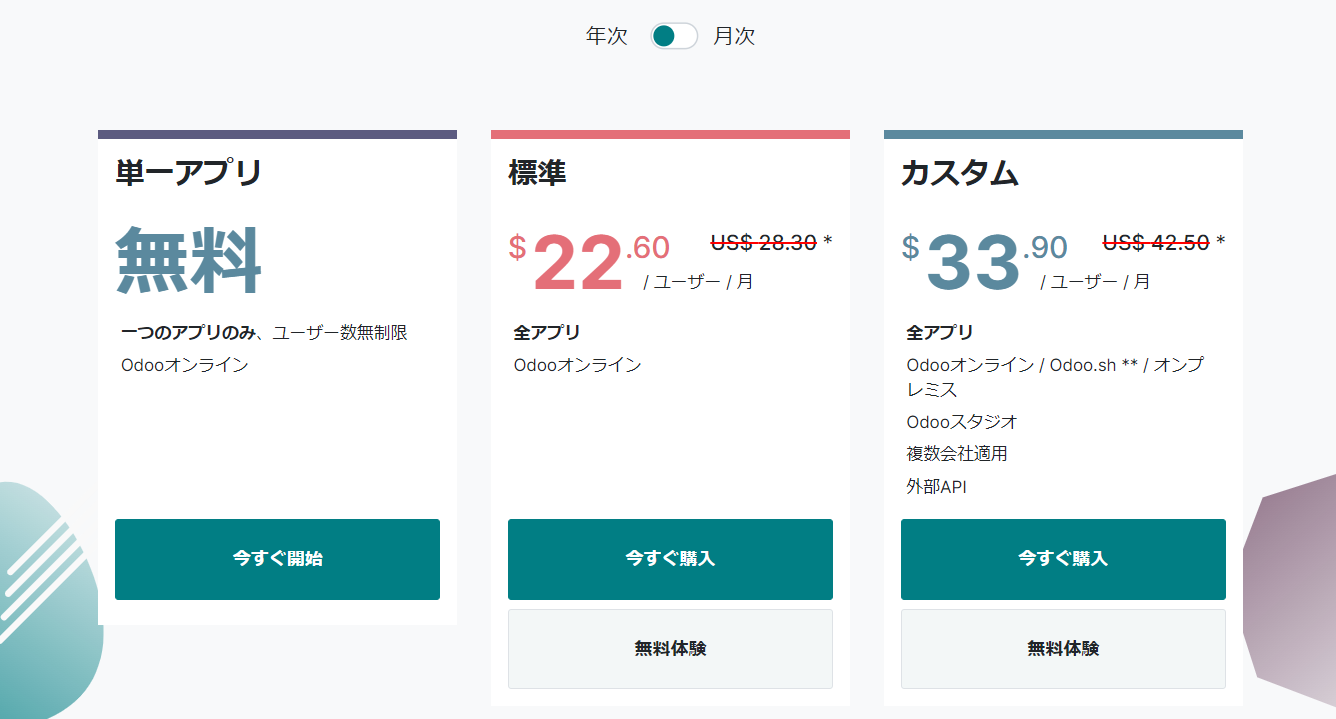
The three pricing plans
- One App Free plan: free regardless of the number of users, where there is a single Enterprise edition app. The free plan gives you free access to one Enterprise edition app on a database hosted on Odoo Online in the cloud, with no limit on users, for good.
- Standard plan: no customisation. $28.30 per user per month ($22.60 in the first year). The Standard plan is the best option for companies that do not need custom development. It provides a standard database hosted on Odoo Online in the cloud, and you can install every Odoo app you need. Install three apps or install seventy, the price does not change.
- Custom plan: customisation included. $42.50 per user per month ($33.90 in the first year). The Custom plan is best for businesses that want to manage several companies in one database, or that need to customise their Odoo database through Odoo Studio, through custom development (databases hosted on Odoo.sh or on-premise only), or through the API.
※ These are the figures for an annual contract. For a monthly contract the figures differ.
※ The discounted price applies only to a new customer's first 12 months, and to multi-year contracts.
※ For which Odoo apps are in the Community edition, please check the Odoo edition comparison page.
The new pricing plans include unlimited support, cloud hosting on Odoo Online, and maintenance.
How existing customers are handled
The pricing plans are new, but the following is in place for customers already using Odoo.
- Where the new price is lower than the current one: this price change makes the subscription cheaper, and gives access to every Odoo app rather than only some of them. Every app becomes available straight away, and the price comes down at the next subscription renewal.
- Where the new price is higher than the current one: as long as the number of users does not change, the current price stands and access opens to every Odoo app. There is no increase in subscription cost from the change of pricing plan.
※ Excluding Odoo Online customers charged monthly
Odoo Experience 2022 Keynote - Vision & Strategy — from the talk
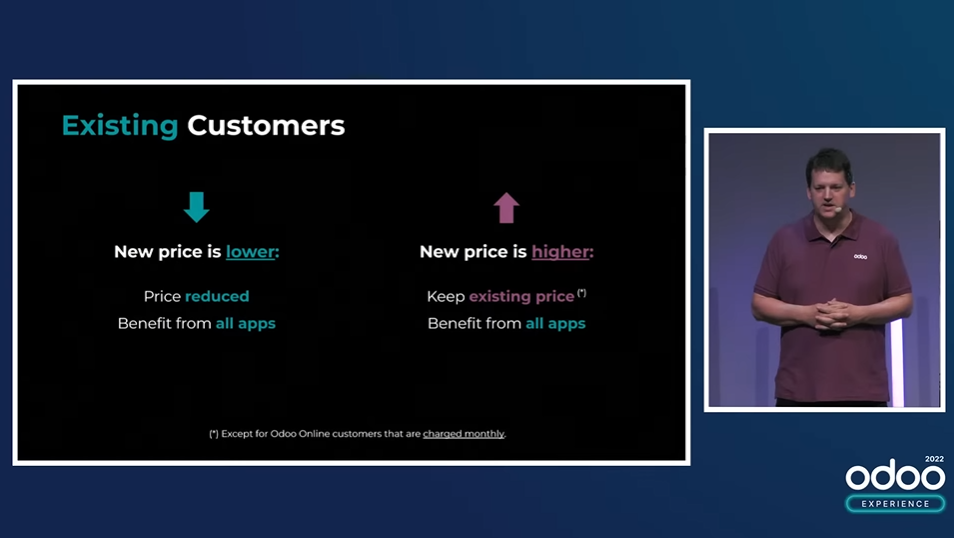
Odoo's pricing so far, and the ideal pricing
Let me explain why Odoo revised its pricing plans — the background, and what it is for.
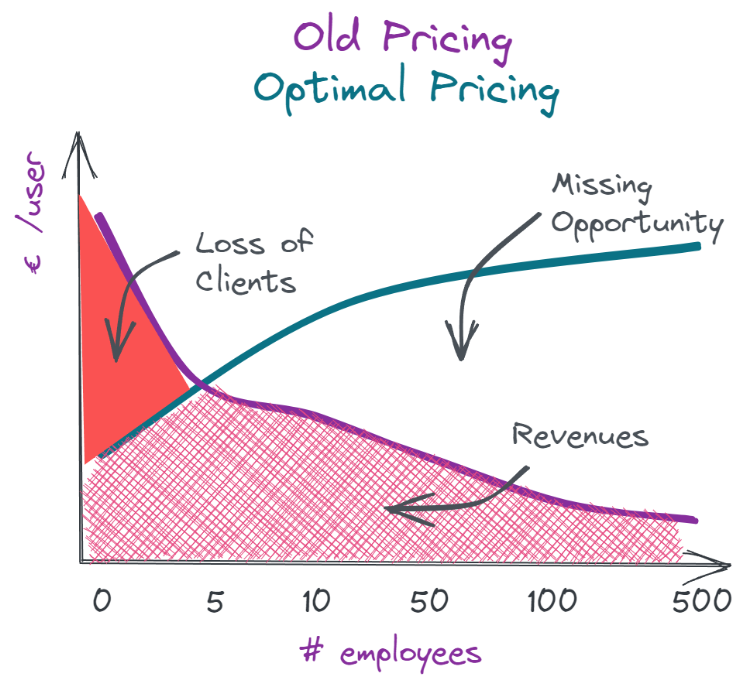
Odoo's price until now was set by the price of each Enterprise edition app installed, plus the number of users.
That is, as the graph below shows, it was a pricing plan in which the more employees there were, the lower the price per user.
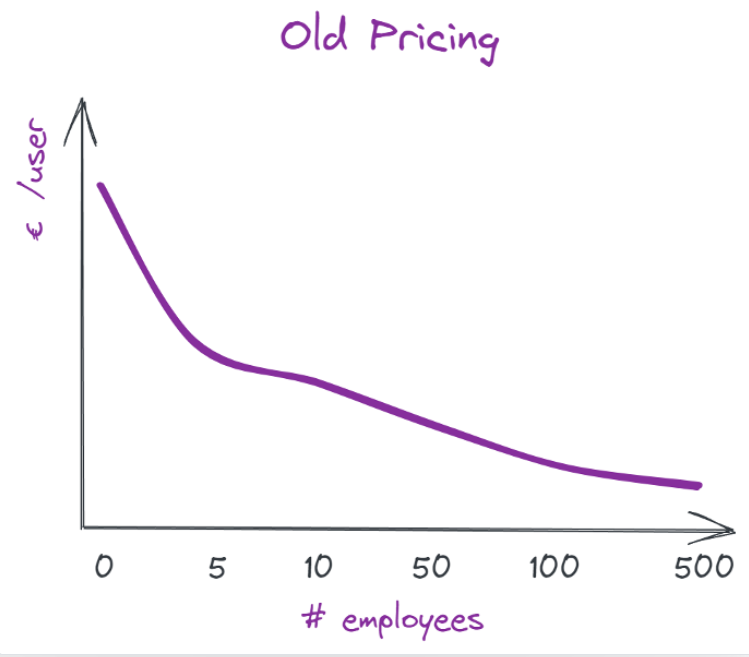
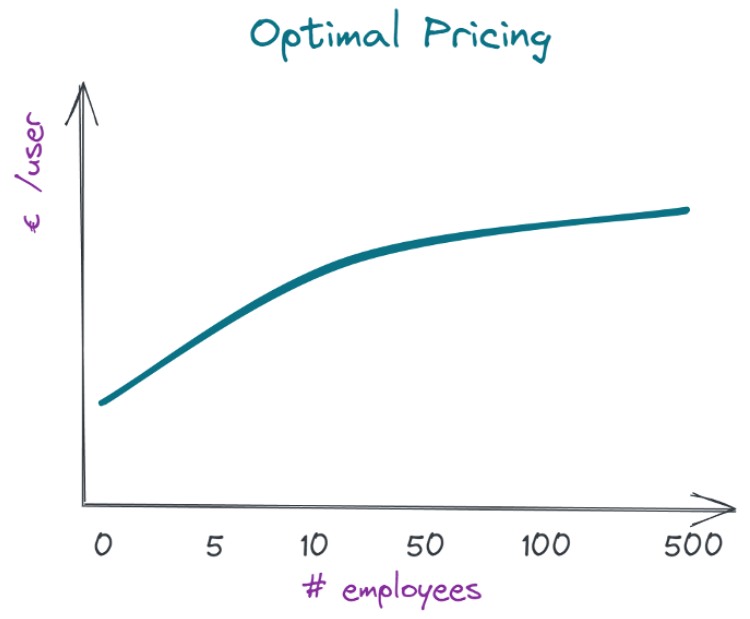
Ideally, the price should be set by the value the customer gets from the product.
Given that a larger company gets more value out of an integrated system, the optimal pricing strategy is one where the unit price per user goes up as the number of employees goes up.
To give an example, in Europe a company with only one user averaged €96 a month, while dividing the app price of a 100-user company by its number of users gave an average of €20.
The pricing plans up to now therefore had two problems.
- Business lost among customers in the one-to-five-user segment
- Revenue lost from larger companies
Behind this revision of the pricing plans lay exactly that mismatch between the product's value and its pricing.
To think about Odoo's true value, let us compare it against competitors' prices.
Odoo is not merely an ERP; it is also CRM, PoS, e-commerce, eSign, HR and a great many other solutions.
Totalling up competitors' prices for those apps gave the following result.
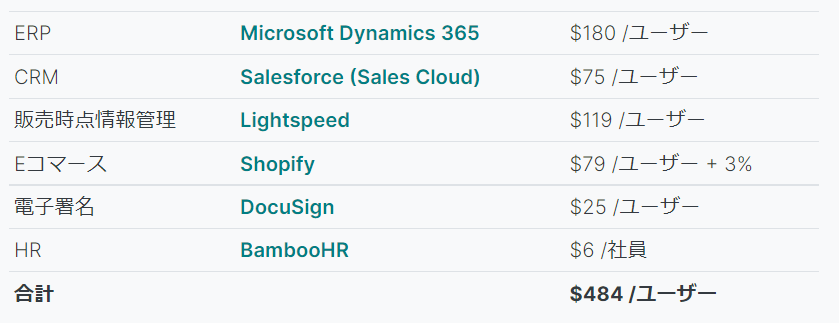
The main apps comparable to Odoo's come to $484 per user on their own.
Odoo includes apps beyond those, and using Odoo also removes the development cost of connecting each piece of software to the others.
In summary
This revision of the pricing plans brings a large benefit to smaller companies, while for companies on the Enterprise edition with many users it is a change for the worse.
That said, because every app becomes available, there is scope to cut costs by migrating current operations that run on software other than Odoo across to Odoo step by step. It is also conceivable that work currently managed by hand could be systematised on Odoo, making it more efficient at low cost.
Unifying your systems on Odoo should also bring savings in the cost of communicating with vendors and of managing contracts, and in managing user IDs and training users, quite apart from the benefit of an integrated database.
On top of that, bringing in a new system usually takes considerable time and cost: gathering information, requesting quotations, comparing features and prices, selecting, getting internal approval. That every Odoo app is available at the same price means many of those steps can be skipped when you extend Odoo sideways into another area.
The Community edition remains free as before, so starting with operations on the Community edition may be one way in.
For a company of any size, I think Odoo is well worth considering.
If you are looking at adopting Odoo, please do try it out first.
For a brief introduction to Odoo, please see the blog posts below. (The information is for V14.0, but it applies almost identically to V16.0.)
Odoo's pricing plans have been revised