
Odoo's pricing plans have been revised reported the pricing change; this is a short look at what effect it has had on Odoo's business, and at what happens next — and what ought to happen.
What the price change brought about
To recap, the October 2022 revision took charging that had depended on the number of users and the apps in use, and consolidated it into charging by number of users alone, with the unit price per user going up. Put simply, the revision favoured smaller operators — meaning those with few users — compared with what came before.
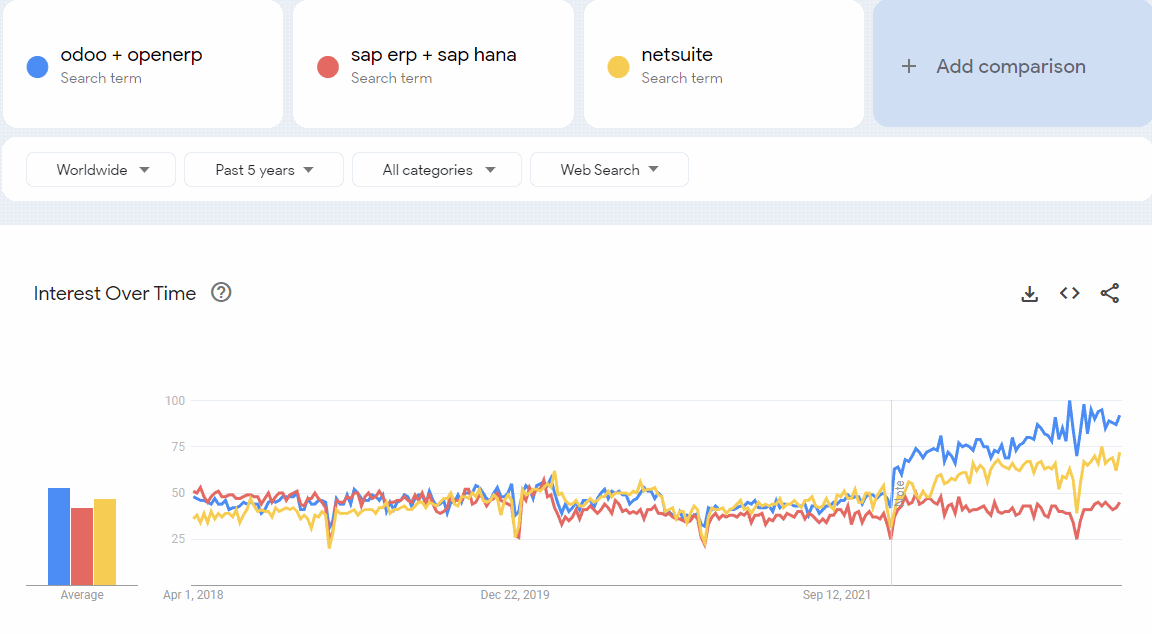
Google Trends does not show the effect of this pricing change clearly, but Odoo's momentum of some time back seems to be carrying straight on, and the gap between it and the other players to be widening. It is not hard to imagine that opening the door wider brought more people searching for Odoo, and I expect a fair part of the recent trend is down to new users.
While Odoo steadily adds users, we often hear concern from around the partner community — particularly from the people who actively put information out there, which is also because we have little contact with those who do not — about a decline in the service quality of Odoo S.A.'s help desk. Our own experience matches it: except in cases such as a clear UI defect, there are many situations where pointing a problem out to Odoo S.A.'s help desk does not get through.
My guess again is that Odoo S.A.'s help desk staff are run off their feet keeping up with user support for new small operators. And with small operators in particular there are likely to be cases where users' IT literacy is not all it might be.
There used to be a help desk for Odoo Enterprise users, and separately from that Odoo S.A.'s own members worked on GitHub issues fairly often and it functioned reasonably well — but lately there is no denying the sense that the GitHub channel is being neglected. (For those of us who want to collaborate in the open and improve the product, that is a great shame.) If the tendency continues, we sincerely hope Odoo S.A. will take steps such as separating the help desk channels for users and for partners. Many of the problems we professionals identify are matters of design, and help desk staff whose main work is explaining how to operate and configure things cannot deal with them.
What happens next, and what to do about it
Leaving the structural problems of Odoo S.A.'s help desk aside, I think the direction Odoo should take now that it has opened the door wider to small operators — making the product easier to understand — has become clearer than it was before. Without that, support buckles and nothing works.
What will come into relief from here, surely, is the question of what to do about localisation. However stress-free the system becomes for a user in Belgium, that does not mean a user in Japan will simply take to it as it stands. Handling the language comes first, which is translation, and adjustments in line with Japanese regulation and business practice are needed too. Localisation has been a problem for a while, but under the new pricing structure its importance must be freshly apparent inside Odoo S.A., because this is where the bottleneck is.
Quartile is carrying some of the product localisation forward, language included, but putting the various user-facing documents into Japanese is not something we can realistically handle ourselves. My sense is that unless Odoo S.A. puts its shoulder behind localisation and gets serious about it — unless it builds a set-up that can do that — it will be hard for Odoo S.A. to serve Japanese users directly as SaaS. We want to give Odoo S.A. what support we can, but watching from the side it is a little frustrating to wonder whether they can draw up a strategy in that area and bring partners in effectively.
Fortunately Odoo's core is open source, and where Odoo itself falls short we can fill the gap through the work of the Odoo Community Association (OCA). For our part, alongside translating on Transifex and raising issues and PRs on Odoo's GitHub repositories, we want to work actively within the OCA too, and build up community assets where we have control.
Photo by AbsolutVision on Unsplash
What the Odoo price change has led to