
On 28 June we held an online event, “Odoo Open Talk — let's take part in Odoo's OSS work! (the theory)”. What follows is the gist of it, the concerns behind it, and where we would like to take it.
How the event came about
As one attempt at getting more information about Odoo shared around, Quartile has for some months now been running an online chat event called “Odoo Open Talk” every few weeks. The numbers are small, but they creep up with each one.
For this one the date had been fixed with the content still open, and it was after inviting a certain Odoo partner to join us in OSS work that we settled on a theme: sharing the reasons why one should take part in Odoo's OSS work.
It is a theme I have long felt strongly about, and a suspicion had been building in me that what Odoo and its partners have lately been saying and doing in Japan “might in fact be pointing the Odoo ecosystem somewhere it should not go”. So although this was billed as a chat, it turned into a session carrying a fairly pointed message from someone who has been with Odoo a long time.
Since we were at it, I called out to several other Odoo partners on X as well, and got no response. If this article reaches you, I would be glad if you took a look at the slides yourself.
Why you should take part in Odoo's OSS work
The gist of my presentation was as follows.
1) Odoo is a product that succeeded by making the most of being open source, and yet the balance between “the open-source world” and “the proprietary world” has lately been coming apart — moving from “coexistence” towards “division”
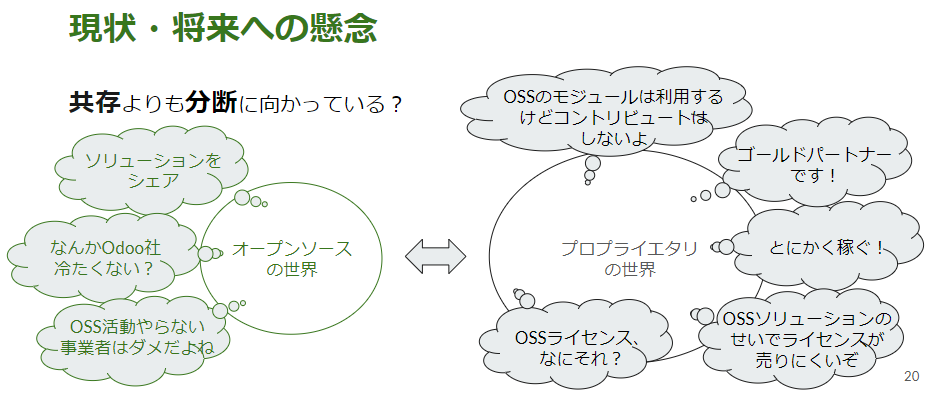
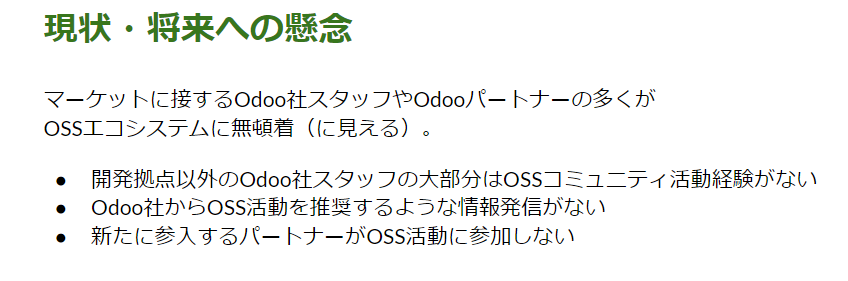
2) A large part of the reason is that the people who came to Odoo after the switch to open core — those at Odoo itself included — have no track record in OSS work
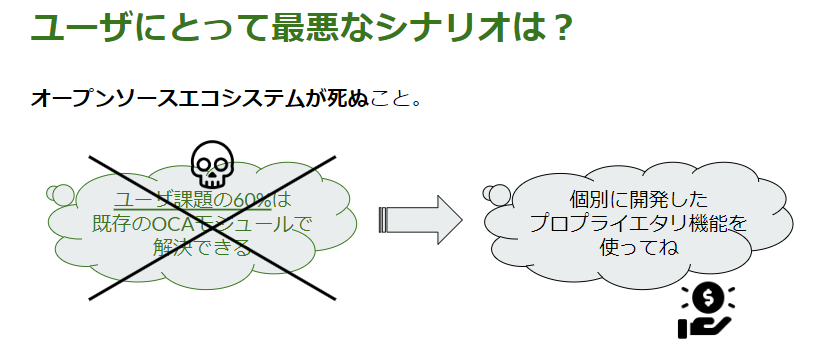
3) If “the open-source world” dies, users are the ones who lose out, and the Odoo ecosystem falls into a downward spiral
4) Everyone involved with Odoo should work together to make OSS activity thrive
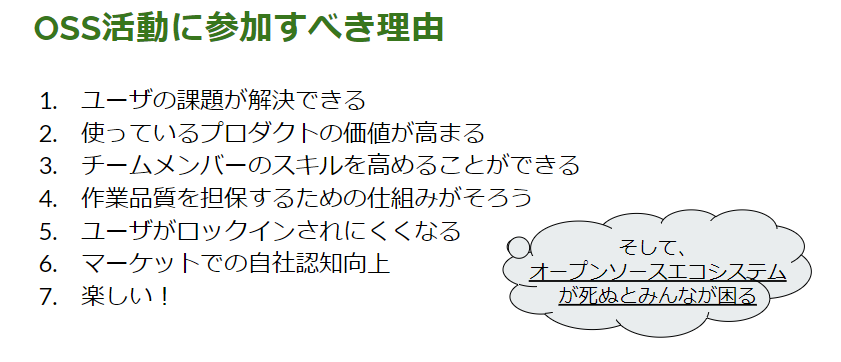
Most of those attending had used OSS but had never taken part in OSS community work, and the feeling they came away with seemed to be “I follow the argument, but what am I actually supposed to do?”
So this event has a sequel. At the Odoo Open Talk scheduled for Friday 19 July, 18:00–19:00, we will go through the concrete steps and the knacks of joining OSS work.
What open source is really worth
Odoo is an open-source — open-core — product, but few players, users and partners alike, seem to me to grasp correctly how being open source acts on the Odoo ecosystem.
For a user, investing in a core business system is a serious matter. The sums are large, the success or failure of the project governs how productive the business is, and through that it weighs heavily on the competitiveness of the business itself. Odoo is an excellent product as ERP software goes, capable and inexpensive, but getting to the point where operations run cleanly brings all sorts of difficulty with it. No product is perfect. Still less one that was never developed for the Japanese market in particular. There are problems by the mountain-load.
What users want to know is which problems there are, and what an Odoo partner can do to get past them.
With other, proprietary business systems, answering that comes with restrictions on what may be said in the open. The code cannot leave the building, and the support channels are closed. There is no venue for building solutions on a community basis. For each problem that comes up the user has no choice but to take support from a service partner, one problem at a time. Add the asymmetry of information and both implementation and maintenance costs run high.
Odoo is different. Because it is open source, it is a product with which “concrete” information is easy to share. Quartile, for instance, often puts out something like this.
Following up the FIFO purchase-return problem posted about the other day, we have put a light refactoring proposal to Odoo core. If it lands, Odoo gets that bit easier to accept in Japan.
https://github.com/odoo/odoo/pull/170470
#Odoo #OpenSource
— @qrtlodoo 26 June 2024
Time being limited, we know that what we post is not always easy for a user to follow — but this is how we share the problem and its solution in the open.
Odoo being an open-source product, a partner who understands the ecosystem and takes the market's problems seriously will raise issues and pull requests on Odoo's own GitHub repository, and will be active in the Odoo Community Association (OCA), the global open-source community around Odoo. Concrete information comes out of a partner like that as a matter of course.
Odoo is often pitched along the lines of “it's cheap because it's open source” or “you can customise it because it's open source”, but what open source essentially is, is having a mechanism through which information circulates openly. Every benefit anyone attaches to the words arises from that, as a by-product.
What a partner's communication ought to look like
Do you ever feel that what Odoo and its partners put out for users carries little in the way of specifics, and speaks of the product's merits in the same identical terms wherever you cut into it? I do, often.
Users may not feel it much, having grown used to it in the bad sense. That is simply how the mainstream products you see every day behave. SAP and Oracle, Kanjo Bugyo and Yayoi Hanbai. In each case the publisher speaks of its own product's merits, and the partners keep step.
Odoo is no exception as a publisher. And that is fine. It is the publisher.
But for the Odoo partners who actually face users in the market to stop at that level is not what should be expected of them. It is because Odoo is an open-source product, one with a mechanism through which information circulates openly.
Odoo certainly is an excellent product as ERP software goes, capable and inexpensive. But we Odoo partners should be doing more than copying and pasting the publisher's slogans and spreading them: we should be putting out sharper, more concrete knowledge won through our own experience, the limits and the things that do not yet work included. That is what serves users and the community, and it is what carries the Odoo ecosystem forward.
Users, please acquire this instinct too. The instinct that concrete information about Odoo coming from a partner is the normal state of affairs. This matters a great deal.
If a partner handles an open-source product that has a mechanism through which information circulates openly and yet puts nothing concrete into the open, think hard about what that means.
Can we grow the number of people taking part?
By rights it would be good if Odoo itself took a view of the whole ecosystem and moved to nurture it, the OSS side included, or at least said something about it. In Japan especially, the proprietary side began to expand before OSS work had taken root, so the balance of what reaches the market tends to tip.
But the Odoo ecosystem is what it is, that included. Odoo suffered a good deal in the AGPL years, recovered after the switch to open core in 2015, and worked its way to the success it has today. The proprietary side may be the louder voice, but the open-source channels are firmly open all the same. To expect the publisher to go out and promote OSS work may itself be a kind of dependence. This is for the Odoo partners, and other players who know the market well, to lead.
So Quartile takes the deliberate position that we should speak in the direction of righting that tipping balance. Starting with this event, we intend to give practical support to players who are interested in joining OSS work. And for users — “raising awareness” sounds grander than I mean it to — we will keep working to convey, through what we ourselves do, the benefits that follow from what open source essentially is: a mechanism through which information circulates openly.
The role of balancer in the market is not one Quartile should be carrying alone. One obvious scenario is that we grow stronger and deliver more of the open-source side's information to the market ourselves — but if other partners would join in, and a habit of sharpening one another while collaborating in the open took hold, the value on offer to users in Japan would widen and the ground would be laid for Odoo to spread here at an accelerating rate. All we can do is work at that, steadily.
An aside — does OSS work do better outside the big city?
One thing I noticed at this event was where the participants — eight in all — were. Not one from Tokyo. Every one of them joined from the regions or from abroad. Seventy per cent of the traffic to Quartile's website comes from Tokyo. And yet that seventy per cent produced nobody, while the remaining thirty produced all eight.
Some of it may be chance, but as a matter of probability the skew looked impossible. What does it mean? To offer a rough hypothesis: OSS community work is easier to push forward precisely outside the big city.
- In Tokyo, where costs are high, work is expected to lead directly to profit, so OSS activity that does not pay in the short term is hard to turn one's eyes to
- In the regions, a shortage of people makes it hard to build a team that can take on something as complex as Odoo unaided, so collaborating with the community makes sense
That is roughly how it felt to me. Too much of a stretch?
There may in fact be a way forward here for businesses outside the big city. Keep at the work and the outlines of this may come clearer.
Feeling our way towards more people in Odoo's OSS work