
At the end of September and the start of October I was in Belgium for OCA Days 2024 and Odoo Experience 2024. Being busy, I never got round to writing it up, and since there is no sign of that easing I am setting it down before the memory fades.
In a word: I am glad we went. For a small team, taking its key members away from the work for a week and spending what it cost, the month's books took a hit. But visiting the place Odoo came from was something I had wanted for years and kept putting off, and I did not want to put it off any longer. Once there, exactly as I had pictured it, we were able to meet a great many people from Odoo and members of the OCA. Seeing Odoo's momentum first-hand, my own picture of how Odoo will develop from here came into sharper focus. That is a result I do not think could have been had anywhere but Belgium.
In this piece I set down what I felt at the Odoo and Odoo Community Association (OCA) events, and my own outlook on what will happen next in the Japanese market.
Odoo's momentum is the real thing
Odoo has momentum, unmistakably. Odoo Experience 2024 ran over three days, 2 to 4 October, at the venerable Brussels Expo, billed as “Europe's largest business and tech event”. The official event page gives more than 35,000 visitors, though that is probably based on the previous year's figure — the 2023 event page, for what it is worth, says more than 15,000 — and the actual turnout this time was, I think, higher still. Fabien, Odoo's founder, used the phrase “the economic effect of 50,000 hotel room-nights” in the opening keynote, and taken at face value that puts attendance at 50,000 or more. That is on a par with the turnout for “Japan IT Week (Spring)” at Tokyo Big Sight in 2024. Put it that Odoo draws that crowd on its own and the momentum becomes easier to picture. Unlike a trade show assembled out of many parts, everyone here gathers under the single theme of Odoo, which gives the hall much more of a common feeling — and communication was lively, between Odoo's people and the attendees, and among the attendees themselves.
Odoo Experience 2024 - Aftermovie
Odoo's strength has always been that it covers a wide range of areas in an integrated way, and the solutions in each of those areas are steadily getting more complete. Normally, spreading yourself that far means enormous cost simply to keep what already exists working, and that becomes the shackle that slows progress. In Odoo's case the modular structure and the business model of supporting only a narrow band of versions have both told, and there is still no sign of the pace easing.
My own reading of it has shifted too — from “there is a feature there for most areas, at any rate, though it is still no match for a SaaS product built for that one area” towards “there are features across many areas, and they are quite usable”. Version 18.0, released at this event, drove the point home again. There used to be plenty of cases where, weighing “the functional advantage of another product” against “the benefit of integrating on Odoo”, the former won. Now the areas where Odoo has overtaken other products on function alone are increasing, and that former advantage is, I feel, disappearing. Once that is so, there is no reason left not to accept Odoo. Odoo is in the phase where simply going on improving the product along the lines it has been will bring the users in of its own accord.
Odoo's own people and the exhibitors alike were visibly full of confidence about the future. Talking directly with Odoo's management, its product owners and the people responsible for localisation, and taking in that positive energy, I could feel that believing in Odoo's possibilities all these years had not been a mistake. Oddly enough, some of the frustration I feel with Odoo from time to time seemed to dissolve as well. Delivering Odoo services in Japan we often throw issues at Odoo's help desk, and the quality of that support is not good, to my sense of it and to that of many people in Japan. When an issue does not come back with the answer we think it should have, I tend to dig my heels in — but perhaps not straining at it, and simply letting it pass, is a way to go too. While we hold on to one small issue, Odoo advances a hundred paces, and the market is actually taking that up.
Odoo is still not widely known in Japan, and that is exactly what makes the situation interesting. I have long played the boy who cried wolf, proclaiming that this wave would reach Japan too — and going to this Odoo Experience, I felt the moment is now close at hand. So, Odoo service providers: are you ready? We are not (laughs). We are confident about the quality of our service, but we have to build up a good deal more delivery capacity.
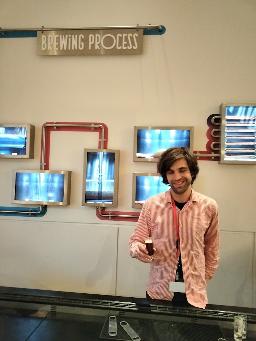
(I dropped into the beer museum wearing an Odoo cap, and a member of staff said: “Were you at Odoo Experience? I'd been meaning to go myself.”)
The OCA's sense of crisis is growing
Out of order, but before Odoo Experience 2024 I attended OCA Days 2024 on 30 September and 1 October, the annual event of the Odoo Community Association (OCA), held in Liège. Each year it gathers the members who carry on Odoo's open-source work; alongside a code sprint, talk sessions and discussions run in every corner on community features, development practice, and how to get more collaboration going in the community. I do not have an exact figure, but I think this year's attendance was around 220.
I have been involved in the OCA's work for years, but this was my first time at the annual event in Belgium. For most of the people I had dealt with online it was also our first meeting in person, and yet it felt oddly like seeing an old friend after a long gap.
Running under this year's event was the theme of how to raise the OCA's presence. It came up not only in the sessions given over to it directly but in a good many of the others as well.
It shows in the tone of Quartile's blog posts, I think, but for some time now the OCA itself has been worried about “the relative decline of the OCA's strength” within the Odoo market. Relative is the operative word. In absolute terms the OCA is getting stronger: its governance arrangements and its tooling have been improved again and again, and both the number of participants and the volume of activity in the OCA repositories are on a gentle upward trend. The worry here is about the comparison with Odoo itself. My rough sense is that where Odoo's strength has gone up tenfold over the past few years, the OCA's has not quite doubled. The OCA's momentum is nowhere near keeping up with Odoo's.
Odoo's momentum these past few years has many causes, but I take it to come chiefly from how strongly improvements to the product itself, and the pricing revision, appealed to the market. The OCA's underpinning of the Odoo ecosystem must certainly have contributed to that momentum, but there is no way to observe the causal link directly.
In the nine years since the Enterprise edition appeared, Odoo's headcount has grown from just under 300 to more than 4,000. Its partners have gone from a few hundred to over 3,000 official ones. Most of the players — employees and partners — who took up Odoo during that stretch do not know much about open source or about the OCA. Their interest runs to selling the product and the services rather than to the ecosystem as a whole, the open-source side of it included. Seen from where we sit, working on improving the product through OSS activity, it often feels as though these players are inside an echo chamber in which their own selling is what drives Odoo forward.
What is wrong with that? To borrow a phrase that came up in several sessions at this year's OCA Days: the Odoo service side is turning into a “market for lemons”. With information asymmetry in place and all manner of providers starting to talk publicly about Odoo, a user with no means of telling them apart cannot work out which provider is any good — and the capable providers who do the OSS community work end up carrying the cost while others free-ride. This has been surfacing in the Japanese market too. Many Odoo service providers depend on the output of contributors working under the OCA and yet, without making that fact public, talk up the merits of their own service.
A market for lemons is, needless to say, not healthy. It can easily weed out the good community players and leave users with nothing but poor providers. An Odoo ecosystem with no good community players left would be a quite different thing from what it is now, and would in time hold Odoo's development back. What troubles me is that a change of that kind is being brought about by people who have had no part whatever in forming the OSS-cored Odoo ecosystem. There is more on this in the posts below, which are worth a look.
- In a World Where the Point of Community Work Gets Harder to See
- Feeling our way towards more people in Odoo's OSS work
The OCA is a gathering of members who share the principle of building good Odoo solutions collaboratively, in the open. Which is why, while everyone grants that Odoo's growth is itself a very good thing, they are troubled that the shift in the balance of power arising from that growth has so far worked in a direction not necessarily favourable to the players who push OSS work forward.
In Odoo's good old fully-open-source days — I will call them that deliberately — activity in the open worked well as an index of a service provider's ability. But once the Enterprise edition arrived in 2015 and the weight of closed elements and licence sales grew, at Odoo and at the service providers both, activity in the open began to get buried.
Against that background, the OCA board put forward concrete measures: raising the value of membership, raising the recognition of contributors, and stabilising the income needed to carry those out. For the detail, watch the video of the session by Virginie, the OCA's CEO.
OCA Days 2024 - Virginie Dewulf - What's New with the OCA?
Can the relationship between Odoo and the OCA be “repaired”?
Odoo and the OCA have not fallen out in the first place. So why speak of “repairing” the relationship? Because the relationship as it stands is hard to call ideal, if what you want is the healthy development of the Odoo ecosystem. As Odoo has grown strong on Enterprise subscription revenue, its interest in the OCA has fallen away in relative terms, and at present very little synergy is coming out of the two working together.
Odoo Experience ran more than 350 talk sessions, and one of the slots was Virginie's introduction to the OCA.
Odoo Community Association: how we build open source Odoo addons & learn from each other
Perhaps because Virginie had a sore throat it finished sooner than I had expected, but it is a good presentation for getting to know the OCA, so do watch it. The last question of the session, incidentally — “Do you have a good idea of how OCA gets to collaborate better with Odoo?” — was mine.
Fabien was in fact at that session, and afterwards there was a moment where he and Virginie fell into conversation. I asked Virginie later what they had talked about: hearing that last question, the one I had put, he had thought there might be something worth doing with the OCA after all. There used to be a meeting arranged with the OCA board members to coincide with Odoo Experience, and that had lapsed over the past few years. He thought a forum of that kind might be worth reviving. Virginie put in a request for a link to the OCA website on Odoo's own site, but on that there was apparently little enthusiasm, the reason given being that there are many associations besides the OCA and the OCA could not be singled out.
Afterwards I had a chance for a brief word with Fabien myself, and he asked how things stand in Japan. What I said was this:
- localisation for Japan is progressing, but very slowly
- while localisation is still behind, community work in particular ought to be encouraged
- but Japan has almost no culture of approaching Odoo in an open-source context
- so Odoo, for its part, should work closely with the OCA and support open-source activity
That was the substance of it.
No visible change may come of this any time soon. But being able to put to Fabien some of the problems I have felt over years of OSS work aimed at contributing to the Odoo ecosystem, going back to the fully-open-source days, and to catch a little of his attention, was a thread of light in the current of concern described above.
With communication like this, it is the accumulation that counts. Virginie's session may turn out to be what leads to a regular forum between Fabien and the OCA; my own message may bear some small fruit somewhere and contribute to a swing back in Odoo's culture, a return to its identity as OSS. Even where no single message lands with much impact, sending them and sowing the seed, in the belief that it is possible, is what matters.
On a different channel from the conversation with Fabien, there was another exchange that may lead somewhere positive for the OCA. When Antony, the CTO, dropped by the OCA booth, Virginie sounded out whether some special arrangement might be possible on the OCA's booth fee, and Antony's answer was that an email next year would be looked upon kindly. The OCA's income is not large — around €100,000 a year at present — so being spared the €2,500 booth fee would help more than a little. And beyond the financial support, the symbolic weight of having a concrete instance of working with Odoo seems to me important in itself.
Even among Odoo's staff in Belgium, the number unfamiliar with the OCA is growing: the long-standing members all know it well, but most of those who joined in the past few years seem not to. Whatever form it takes, having Odoo and the OCA work together, and more people at Odoo with a point of contact into it, strikes me as necessary to any return to a healthy ecosystem.
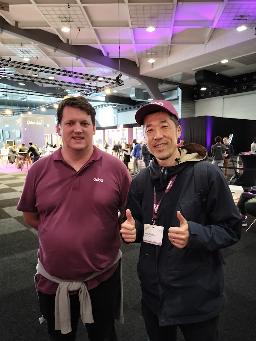
(With Fabien, our first meeting since Hong Kong about eight years ago. Give me a thumbs-up too, Fabien.)
What happens next in the Japanese market
In the short term and at the macro level, I expect a period of confusion. New entrants with no experience of open-source community work will multiply, Odoo's own set-up for the Japanese market will take time to catch up, concretely useful Japanese-language information will stay scarce, and more projects than need be may end in “failure” — or at least be judged failures in hindsight.
To repeat myself: Odoo's momentum is the real thing, and it will certainly reach Japan. The conditions for it are already falling into place. On localising the product, Quartile has built up no small amount. What holds the inflow of Odoo back at the moment is the supply side, which is the bottleneck. Given a market like that, all manner of players will appear from here on, offering services with Odoo as their stock in trade.
What follows is an acceleration of the market for lemons. Something of the sort already existed; it will get worse. The new entrants will not for a moment think that they are the ones making the market for lemons. That is how it goes. An ecosystem is always broken by incurious entrants who do not understand how it came about or how delicately it is balanced.
Odoo will probably go on growing for a while even so. And the product's own progress will, I think, bring the market for lemons a certain stability of its own. What used to weigh most in making an Odoo implementation succeed was knowledge of the low layer — programming, servers and the like — and as the product and Odoo's services have advanced, I feel that weight shifting to the high layer: understanding Odoo's features, and the ability to consult. With the low layer stable, nothing falls over too badly.
OSS community work, at the OCA and elsewhere, does not feel to me as though it will spread in Japan on the present course. If it does spread, the likeliest scenario is that Quartile's headcount grows and the volume of community activity grows in proportion. But as a support for the Odoo ecosystem that is somewhat fragile. For a healthy state of affairs, what is wanted above all is Odoo service providers other than Quartile taking part in community work. (We are waiting!)
What Quartile will do
One thing I came away thinking we should do is get on Odoo's own scenario. That is: implement Odoo for client companies faster and at lower cost, keeping customisation out and quality at a set level. This is nothing new — Odoo has recommended this method of implementation for a long time. But as someone who knows both Odoo and the market, my feeling had been that it was still too early for Japan. Seeing how Odoo is thriving in Belgium, and looking again at what we have built up for the Japanese market, I felt the time had come to bring this approach to the front. An ERP service that a very small company can adopt without fuss — that is what we are aiming at. There are parts that still need building out, but we intend to develop the service along these lines.
Alongside that, we will take up OSS community work more deliberately. As written above, and setting aside whether it is good or bad, on the present course community work will shrink in relative terms, the way water runs downhill. As the market for lemons advances, users will find themselves, without noticing, in a market that denies them the benefits of open source they ought to have had. Quartile will keep working at the OCA and intends to commit more deeply in several areas. In concrete terms, since returning: I, Tashiro, stood in the 2024 OCA delegate election and was duly elected. We also bought OCA memberships for every member of Quartile — belatedly, and modest as it is. We will go on supporting the OCA's running and its work, in resources and in funds, for what little we can do. Above all, the single element that makes Odoo what it is, is that it is open source. What is good about open source lies in collaborating in the open and sharing what one knows. Quartile means both to embody that spirit itself and, wherever a neighbouring provider has the will to take part in OSS community work, to give whatever support that takes.
Coming out of this trip to Belgium, I can picture clearly the direction to take for the time being. There is an enormous amount to do. Taking care not to let enthusiasm run ahead and spin the wheels, we will work through the tasks one at a time, towards a better future.

(Even Kanda-san, who normally looks bored at work, seemed to be enjoying Belgium.)
Odoo's momentum, the OCA's sense of crisis, and what happens next